What is a gabion wall? The gabion wall has been widely used as a structural framework in civil engineering and landscaping work because of its strength and flexibility. It originates from the Italian word “gabbione,” which literally means “big cage.” The wire mesh cages are filled with materials like rock, concrete, or, in some cases,… Continue reading Gabion wall
Geotextiles, geomembranes, geocells, geonets, geotubes, uniaxial and biaxial geogrids, geocomposites, and similar products are collectively referred to as geosynthetics, a class of engineered polymeric materials that play a pivotal role in modern civil engineering and environmental management. These innovative materials are manufactured from synthetic polymers and are designed to enhance the performance and durability of… Continue reading Functions of geosynthetics
What is freeze-thaw weathering? Freeze-thaw weathering is a natural geological process where water infiltrates cracks, crevices, and porous materials such as rocks and structures. It is also known as frost shattering. As temperatures fluctuate, the water freezes and expands. This exerts a significant pressure on the surrounding rock, leading to the formation of fractures. This… Continue reading Freeze thaw weathering
What does flexural rigidity mean? Flexural rigidity is defined as the capability of a structural member to resist bending when influenced by external forces. Within civil engineering, it is a vital parameter that determines how elements like beams, slabs, and planks respond to applied loads. Structural members made from materials like steel and reinforced concrete… Continue reading Flexural rigidity
What is a fencing net? A fencing net is a sort of barrier netting made up of a mesh of either flexible or rigid material, designed to enclose areas, ensure safety, or restrict access. Application areas of such nets are quite diverse and serve certain basic functions around residential and commercial premises, agricultural lands, and… Continue reading Fencing net
Overview of fatigue Fatigue can be defined as progressive loss of a material resistance due to repeated stress or strain. With time, even the most resilient materials develop cracks or breaks due to constant load cycles. Therefore, understanding these processes is of extreme importance for predicting the durability and reliability of materials used in various… Continue reading Fatigue life
What is fatigue cracking? Fatigue cracking is a typical type of distress (or failure mode) in structural materials, especially in asphalt and concrete buildings. This occurs when a material, such as asphalt or concrete, is subjected to repeated cycles of stress or strain that gradually degrade its structural integrity over time. Dissimilar to acute failure… Continue reading Fatigue cracking
What is fascia vegetation? Fascia vegetation refers to plant life that is strategically integrated across the facades of buildings, those visible bands or panels that run horizontally across the exterior of a structure. This increases the aesthetic value of urban architecture while adding an ecological component. For a civil engineer, this is done under strict… Continue reading Fascia vegetation
Meaning of erosion control The natural environment, through the different elements of nature such as wind and water, causes the movement and breaking of soil, stones, or sand. This is the reason why uncontrolled erosion can be dangerous to the environment and also the buildings, hence erosion control is a necessity. Proper management not only preserves natural… Continue reading Erosion control
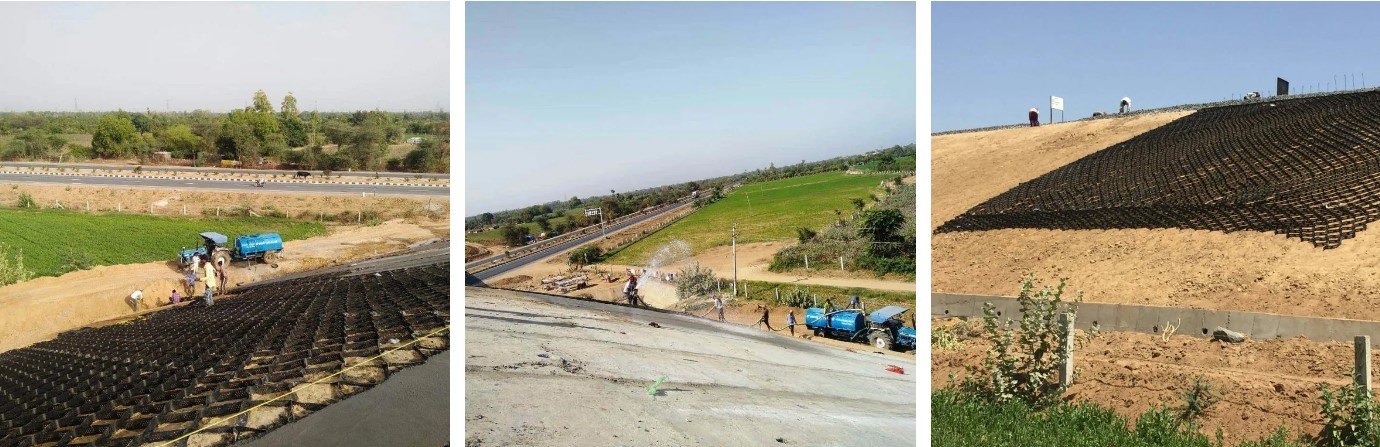
Equivalent diameter (Deq) in geocells The performance of geocell systems depends not only on material strength but also on the geometry of the expanded cellular structure. While parameters such as cell depth, polymer stiffness, and seam strength are commonly discussed in design, the plan geometry of the expanded cell pocket also plays an important role… Continue reading Equivalent diameter (Deq) in geocells