
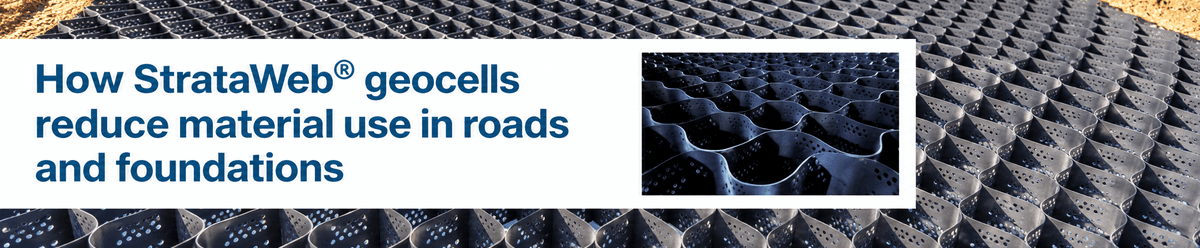
StrataWeb® geocell is a honeycomb-shaped reinforcement system used to stabilise roads, pavements, and foundations by holding fill material firmly in place. It's often thought of as a way to cut material costs, but its real value goes further: it changes how a road or foundation performs under load, with material savings following as a natural result.
When people hear "material optimisation," they often assume it just means using less aggregate or fill. With StrataWeb® geocell, that's not the main benefit. The real value lies in how it improves the way a road, pavement, or foundation holds up over time.
Why projects often use more material than they need
Ground conditions beneath a project site are rarely fully predictable. Soil behaves inconsistently, and moisture and traffic loads change over time.
Because of this uncertainty, many projects add extra fill material as a buffer. It's a reasonable instinct, but it doesn't always solve the underlying problem, overbuilding a pavement or foundation can use far more material than is actually needed.
The real challenge isn't a lack of material. It's how well that material performs, which is exactly what geocell reinforcement is designed to address.
Why just adding more material doesn't always work
It seems logical that a thicker pavement should hold up better. But thickness alone doesn't guarantee good long-term performance.
Without something to hold it in place, loose fill naturally shifts and spreads under repeated traffic. Over time, this movement leads to ruts, dips, and a surface that gradually loses strength, even when plenty of material is present. The material isn't failing because it's the wrong choice; it's failing because nothing is keeping it in place.
That's the core function a geocell system like StrataWeb® is built to address: helping the material that's already there do its job better.
How StrataWeb® geocell helps
StrataWeb® geocell holds fill material together within a connected honeycomb structure, so instead of shifting as loose, separate pieces, it behaves more like a single, solid layer. This has a few practical effects:
- Weight and pressure spread more evenly across the ground underneath.
- The surface holds up better over time, with less sinking, shifting, or wear.
- A wider range of fill materials, including locally available or lower-cost options, can be used effectively, since the structure itself does more of the work.
- Less need to overbuild as a safety margin against unpredictable ground conditions.
The material hasn't changed , but how it holds up under everyday use has.
The bottom line
Case studies and field use of geocell reinforcement point to meaningful improvements in how roads and foundations handle everyday wear, heavy use, and long-term stability compared with unreinforced fill. Optimising material use isn't about cutting corners; it's about making sure every part of a project is working as hard as it can. StrataWeb® geocell helps build more durable, cost-effective roads and foundations by improving performance first, with material savings following naturally as a result.