
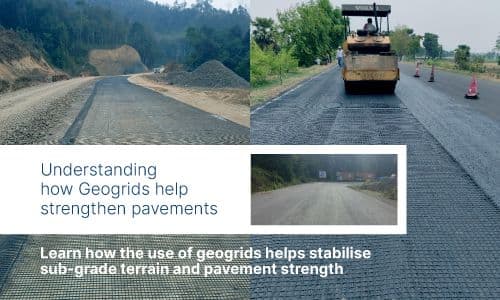
Geogrids are a type of geosynthetic material used for mechanical stabilization and soil reinforcement in construction. These large, flexible rolls of polymers follow a grid-like pattern with intersecting openings called apertures. Depending on the application, geogrids are inserted either on top of the subgrade material and/or within the base or subbase aggregate layers, depending on the California Bearing Ratio (CBR) value of the soil on-site and other design considerations.
Geogrids mechanically strengthen the unbound layers of aggregate by confining the aggregate particles within the apertures, creating a mechanically stabilized layer. This layer manages differential settlement, decreases necessary fill depths, caps weak deposits, and enhances dynamic traffic loading and bearing capacity, ultimately leading to a more stable pavement structure. The use of geogrids improves the performance and durability of the pavement system. Their inherent material tensile stiffness and ability to interlock with aggregate enhance the performance of the overlying aggregate layer, which in turn protects the subgrade, by reducing lateral aggregate movement through the interlocking of the aggregate within the geogrid’s apertures.
Significance of geogrids for subgrade stabilization
The purpose behind using geogrids for stabilization in pavement systems is to reduce or minimize rutting, increase the stiffness of the aggregate layers above the subgrade, and distribute loads more evenly to prevent differential settlement.
Whether a geogrid is necessary or not is determined by the subgrade conditions and overall pavement design requirements. An overlooked factor is the quality of the subgrade itself, which, although it may have soil with a robust Resilient Modulus (MR), can lose strength when saturated with water or subjected to iterative dynamic loads. This can also occur due to the presence of low-plasticity fines or fine sands in the subgrade, leading to a reduction in its strength. By distributing the load and leveraging tensile strength, the structural capacity of the reinforced soil layer is significantly increased. The benefits of geogrids for stabilization are as follows:
Improving subgrade stability:
The primary role of geogrids in pavements is to provide mechanical stability to weak subgrade soils. By interlocking with the overlying aggregate, the geogrid creates a mechanically stabilized layer that confines the aggregate particles. This minimizes lateral spreading and enables a more uniform distribution of load onto the subgrade. As the paved road ages, this is key because the subgrade will undergo moisture content changes and other fluctuations (like those from freeze-thaw cycles in relevant climates), which must be addressed to avoid failures, cracking, rutting, and other maintenance challenges.
Lesser aggregate fill needed:
Geogrids reduce the amount of aggregate required in the pavement structure by up to 15-20%. This makes it an economical choice and offers a more sustainable construction process. By improving the shear strength of the reinforced layer, we no longer need thick layer upon layer of aggregate material. Instead, a thinner layer effectively distributes loads.
Easy installation:
Geogrids are easy to install when compared to other subgrade stabilization methods. Geogrid installation doesn’t require highly specialized labor or specialized equipment. This is another factor that helps reduce the overall cost of the project.
Extended pavement life:
The use of geogrids in subgrade stabilization can help extend pavement life by providing a strong and durable foundation. With reduced maintenance costs, minimized degradation of the paved structure, and longer maintenance cycles, we see longer lifespans for pavements using geogrids.
Sustainable alternative to traditional mechanical methods:
By reducing the amount of aggregate needed for the project, geogrids also reduce quarrying activity required to obtain aggregate fill, as well as the logistical costs of transporting materials from the quarry site to the project site. This not only affects the project’s net carbon footprint but is also an important consideration for ecologically sensitive regions where extensive excavation is not feasible.
Factors to consider while selecting geogrids for stabilization
For pavement design, various factors that impact pavement lifespan must be considered at the design stage. Factors such as traffic volume, traffic load, CBR value, and environmental conditions must be taken into account when developing project plans. This is where Strata Geosystems’ extensive experience in global projects becomes valuable. We partner with you and guide you through the following aspects:
- Help you understand lab and site-tested ultimate tensile strength values, low creep factors, and stiffness properties that can reduce the amount of aggregate fill material needed by up to 20%.
- Aperture sizes and shapes that suit various aggregate types and gradations and are compatible with the underlying soil types (subgrade), with customization options.
- Compatibility with soil, accounting for chemical, environmental, and mechanical degradation, while remaining inert due to the use of a trademarked coating material.
- Installation guides to ensure the process is understood, even with readily available labor, resulting in cost savings.
- Conducting a cost-benefit analysis to identify the optimal mix of products for reducing lifetime costs.
- Strata Geosystems’ design recommendations are tailored to your unique needs.
Geogrids for pavement enhancement
Geogrids have three key benefits: they improve the trafficking performance, longevity, and cost–effectiveness of a given project. In subgrades which would typically need high levels of mechanical stabilization, today geogrids deliver high value over the life of a project. For example, for the Kohima-Bypass Road in Nagaland, there were project goals which needed to be met. Specifically, the project goals included a design that supports dynamic loads and reduced maintenance cycles, given the remoteness of the site.

The initial parameters included a subgrade California Bearing Ratio (CBR) of 10% and a traffic intensity of 50 MSA (Million Standard Axles). The optimized design ultimately featured two layers of SGB Grid –our biaxial geogrid: one within the Wet Mix Macadam (WMM) and the other within the granular sub-base. The inclusion of SGB Grid had a confining effect that minimized lateral aggregate movement. This resistance to lateral spreading significantly reduces vertical deformation (rutting), resulting in superior stability under traffic loads compared to unreinforced sections.
Our solution allowed for easy installation using readily available labor (another cost saving measure), reduced layer thickness to conserve natural materials, and decreased maintenance needs. The flexibility of SGB Grid promoted better interaction with aggregates in the pavement, enhancing fatigue and rutting design life, and facilitating economical and rapid construction.
Choose Strata Geosystems for a best-in-class experience in end-to-end project management for all your geotechnical challenges. With certifications from ASTM, ISO, NTPEP, ISI, BBA, we’re poised to meet your requirements with independently tested lab reports and three decades of experience.