
What is thermal cracking: its definition, types and causes
Thermal cracking is the formation of cracks in concrete and asphalt structures due to temperature fluctuations that induce expansion and contraction of materials. This phenomenon compromises the structural integrity of infrastructure, leading to costly repairs and safety concerns. Thermal cracks are not limited to mass concrete structures but also others, such as pavements, concrete structures working in high-temperature environments, etc where mechanical expansion in response to temperature fluctuations occur.
Types of thermal cracking
Thermal cracking poses a great challenge that compromises the longevity and performance of structures. Understanding the different types of thermal cracking is essential for effective management and prevention strategies.
Transverse cracking
Transverse cracks are cracks that run perpendicular to the centerline of a roadway or a structure. As the pavement cools, it contracts, and if internal stresses exceed the material’s tensile strength, cracking occurs. This type is non-load related and appears irrespective of traffic loading conditions. The cause for it is a weak subgrade, or weak soil underlying the paved road.
Longitudinal cracking
Longitudinal cracks run parallel to the centerline of pavement or structure. These are caused by issues such as layers, fatigue from load stress, or poor joint construction. While planning, if the soil hasn’t been stabilized to handle repetitive loading, and compaction to lock the soil and improve its tensile strength, these types of cracks tend to form quite quickly.
Block cracking
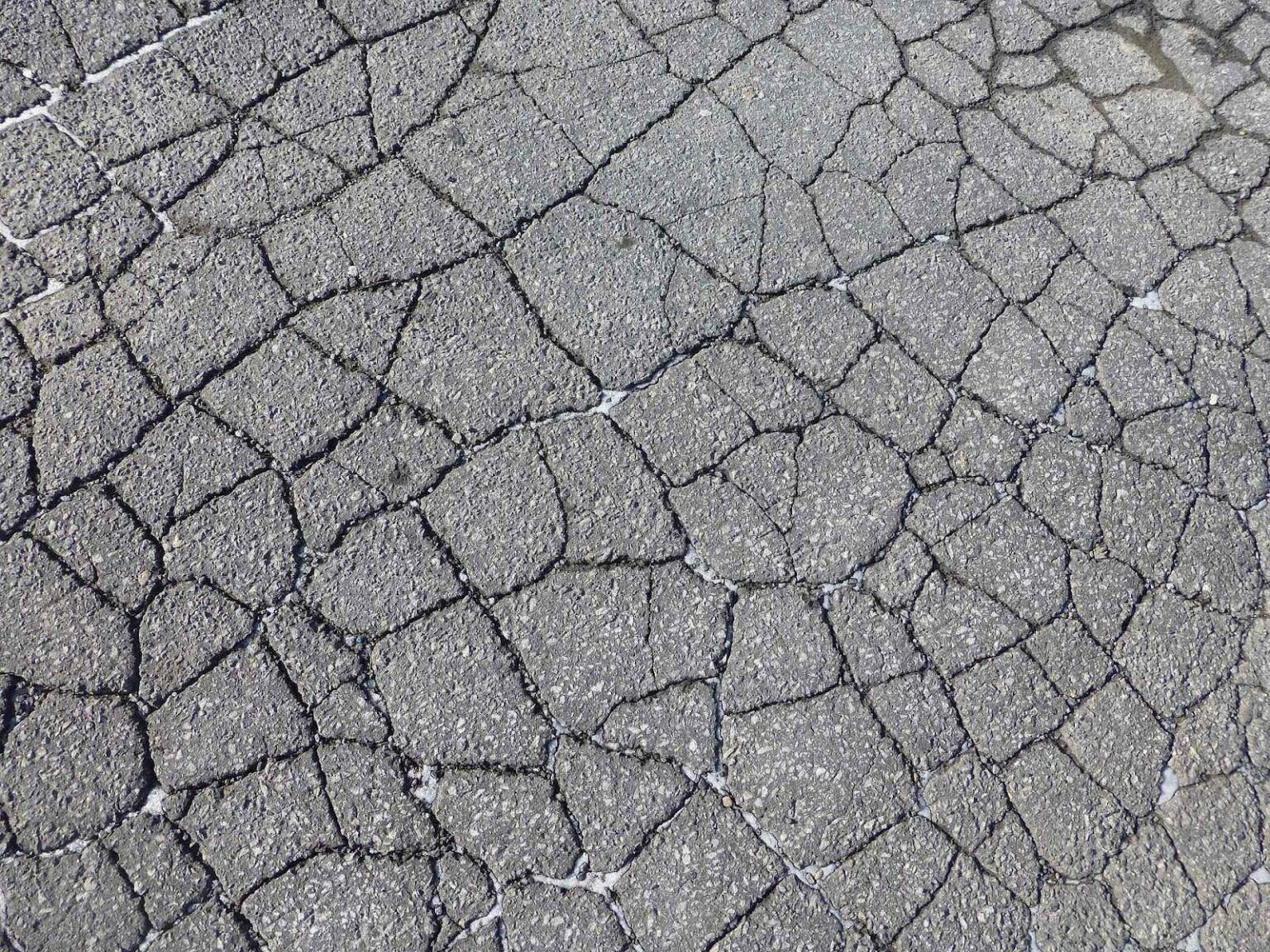
Block cracking appears as interconnected rectangular patterns. It is predominantly caused by the shrinkage of asphalt pavements, which fail to expand and contract adequately with temperature changes. The condition is exacerbated when the asphalt binder is of low quality or if the mix was prepared too dry.
Plastic shrinkage cracking
Plastic shrinkage cracking occurs when the concrete is still plastic and is caused by surface shrinkage of the concrete. When the rate of moisture evaporation from the surface exceeds the rate of the bleed water (excess water that rises to the surface of freshly poured concrete), this type develops. Appearing in the first few hours after concrete placement, plastic shrinkage is often short and localized.
How can thermal cracking in concrete be predicted?
To figure out, if a concrete slab is prone to cracking, prediction methods are useful with each employing different methods.
PCA method
The Principal Component Analysis method is a multivariable statistical approach. The method analyzes and reduces the complexity of variables affecting concrete’s thermal behaviour. Relevant variables such as temperature gradient, heat of hydration(heat released as the cement reacts with water), cement content, and size of the concrete mass are collected. The method calculates 10°C temperature rise for every 100kg of cement.
Shmidt’s method
Shmidt’s method is a simplified procedure based on the size of the concrete structure and the heat of hydration. Using Shmidt’s equations, the thermal stresses are predicted based on the temperature differences between the center and surface of the concrete element. This method should be performed by an experienced engineer. However, this is less applicable to smaller concrete elements.
ACI 207.2R Graphical method
The ACI 207.2R method involves graphical charts and equations based on empirical data. The temperature gradients and stresses are analysed by evaluating the heat of hydration of the cement. Even though simple to use without extensive data collection, it can be less accurate in highly dynamic or complex projects.
Acoustic Emission Testing for Asphalt Pavements
The acoustic emission testing (AET) techniques assess low-temperature cracking performance in asphalt pavements. This approach allows the evaluation and characterization of various asphalt binders and mixtures, including recycled materials. Sensors are used to detect AE and then convert the waves into electrical signals so that it can be recorded.
Repair methods for thermal cracking
Despite our best efforts, cracks might appear under certain circumstances. It is vital to address these promptly to limit the further damage. Here are some of the common repair methods:
Crack injection
In the crack injection method, a liquid epoxy or polyurethane resin is injected into the fractures to fill and seal it. The resin prevents water penetration and maintains the structural integrity of the concrete. This method is effective for narrow cracks.
Routing and sealing
In the routing and sealing process, the crack is widened and cleaned using specialised tools. Then, a suitable sealant is applied to fill the void which provides a flexible barrier. This is recommended for wider cracks.
Overlay or resurfacing
In cases where the thermal cracking is extensive, overlay or resurfacing is applied. The method involves applying a new layer of concrete or a specialised overlay material to the existing surface. The overlay not only covers the gaps, but also reinforces the structure, enhancing its durability.