
In civil engineering, embankments significantly stabilize structures where natural topography does not meet the standards. Materials like soil, sand, and stones are used to raise the levels of railway lines, dams and roads above the ground. Sand has engineering properties of drainage and compaction and it has good strength and permeability making it ideal for constructing embankments.
What is the definition of sand embankments and their key properties?
Sand embankments are used for road construction, railway lines, and flood control systems to provide them strength and stability. Due to its permeability and shear strength, sand becomes an ideal choice for dam construction as well. Its key properties are:
- High Drainage Capacity: Sand allows rapid water movement, reducing pore water pressure and minimizing the risk of instability due to waterlogging.
- Low Cohesion and Shear Strength: Compared to clayey soils, sand has low cohesion, which can affect slope stability requiring reinforcement (e.g., with geotextiles or T Blocks).
- Rapid Consolidation: Sand consolidates quickly under load, making it suitable for faster construction timelines compared to cohesive soils that require staged loading.
- Grain size distribution: Sand comprises loose, granular particles, well graded with grain size distribution which lowers the possibility of risk of water accumulation. With this grain size distribution, it becomes easier to stabilize the structures.
- Compaction characteristics: The stability of sand embankments depends upon their compaction abilities as well. As sand can compact rapidly when dry, it becomes more resistant to settling load.
- Permeability: Sand offers great permeability and it doesn’t lead to pore water pressure inside the embankments to build up. The drainage qualities of sand embankment make it ideal for dams.
- Shear strength: The shear strength parameters are used to calculate the stability of the slope of embankments. Construction of slopes with low shear strength materials poses a risk of collapse of structures.
How does the construction process of sand embankments take place?
Following the given five essential construction steps, the process of sand embankments can be easily understood.
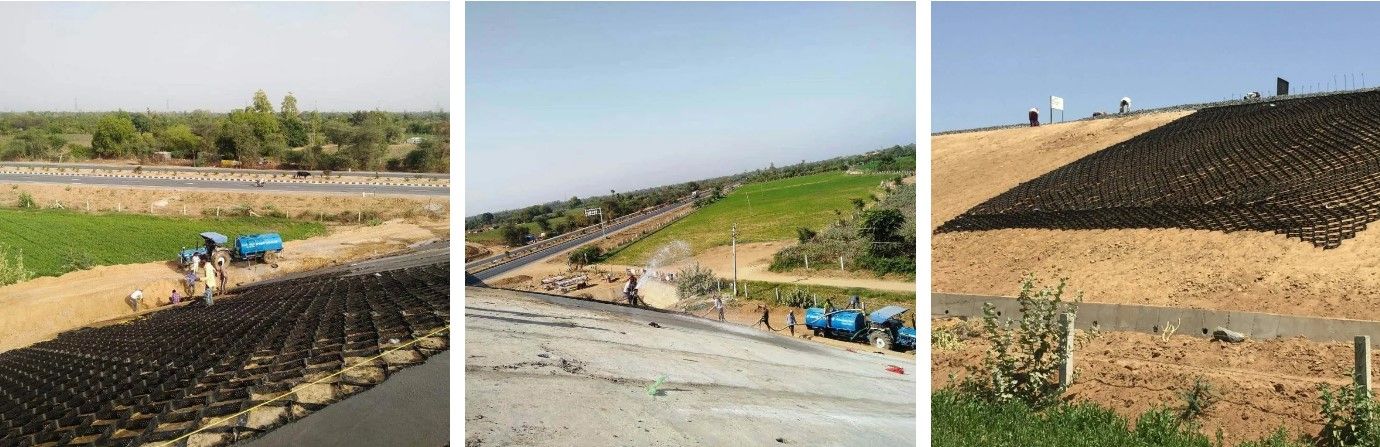
- Site preparation: The first step of site preparation for sand embankments involves setting up the site by clearing all trash, topsoils, and vegetation. Since a stable sand embankment needs a level base, civil engineers have to be cautious here.
- Sand placement: After the formation of a level base, there is the placement of a geotextile membrane to keep the sand separated from the weaker subsoils.
- Compaction: This involves building layers of sand embankment with each layer being compressed using mechanical methods, such as vibratory rollers before the next is added. This provides the strength and density it needs to hold the load without settling.
- Slope formation: In this step, the shaping gradient of surfaces is constructed and given a shape for the embankments. Gentler slopes are preferred over steeper ones because the former is less prone to landslides.
- Erosion control: Lastly, measures for erosion control such as retaining vegetation and application of geosynthetic materials are done.
What are the common types of applications of sand embankments?
- Road construction: While building roads and highways, sand embankments are used to elevate the roads above flood level. They also offer a strong foundation for structures and enhance drainage.
- Railway embankments: In constructing railroads, sand embankments are used to raise the track heights which reduces the possibility of track deformation from water buildup.
- Flood protection: Sand embankments can act as levees or dikes in flood-prone areas, shielding nearby land from rising water levels.
- Bridge approaches: Dams are built by integrating sand embankments as they offer sheer mass which helps to hold water and embankments are also used to transfer water pressure to the valley walls while ensuring effective drainage.
What are the advantages of using sand embankments?
- Cost-effective: Due to the easy availability of sand in huge quantities, it costs cheaper to use it. Since material and transportation costs are minimal to negligible, it becomes an easy choice for embankments.
- Ease of construction: Sand is so lightweight and works as an embankment for the majority of the project. It offers great sheer strength and permeability that can be compacted easily.
- Excellent drainage: Areas with high rainfall can also use sand embankments because of their excellent drainage qualities. It reduces water buildup and slope instability.
- Stability and strength: The combination of large grain size and loose particle arrangement in sand provides high permeability and shear strength, offering excellent stability for structures built on sand embankments.
Thus, sand embankments offer a complete package for civil engineers with long-lasting support to the structures. Starting from its easy availability and superb drainage qualities, it has become the top choice and important in infrastructure such as roads, highways, railways, and dams. Sand embankments if used well can offer an effective solution to all civil engineering challenges.