
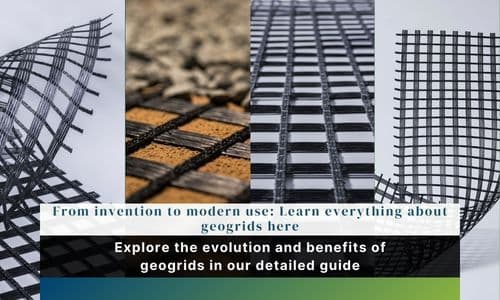
Geogrids are geosynthetic materials that act like a strong mesh or grid to strengthen unstable ground and reinforce soil structure. They have high tensile strength and a higher elastic modulus than soil, allowing them to distribute loads more effectively and provide reinforcement in construction applications than they otherwise would.
Geogrids are used for soil reinforcement, reinforcement of retaining walls, slope stabilization, etc. Geogrids are formed by intersecting grids of elements extending in two directions, one in the machine direction (longitudinal) and the other in the transverse (or cross-machine) direction, forming the shape of the apertures. These apertures vary depending on application and the manufacturer’s specifications. Companies make geogrids from different plastic materials like polyester, polyvinyl alcohol, polyethylene, or polypropylene. At Strata Geosystems, we manufacture Polyethylene Terephthalate geogrids, also known as PET geogrids.
There are four kinds of geogrids: uniaxial, biaxial, triaxial, and composite. We at Strata Geosystems specialize in uniaxial and biaxial geogrids, which form the backbone of many soil reinforcement and ground improvement applications. Uniaxial geogrids are oriented in the longitudinal direction of the extruded sheet of polymer, giving a mesh structure of long and narrow ribs. Biaxial geogrids extend in both longitudinal and transverse directions so that the stress is uniformly distributed on both sides. Geogrids work primarily by interacting with granular soils (like sand and gravel), where the soil particles penetrate the apertures and get interlocked. This interlocking increases the shear capacity of the granular infill. Other advantages include soil stabilization, increased load-carrying capacity, and resistance to erosion.

How were geogrids invented?
The original concept of a geogrid was put forth by Dr. Brian Mercer through the patented ’ Netlon Process ’ in the late 1950s and early 1960s. The Netlon Process involves melting polymer and extruding it through a specialized die to produce a net structure that is integral in design. In the early 1970s, the use of extruded polymer mesh structures became popular in civil engineering, much like where we are with geogrids today. There are various forms of geogrids, such as extruded, woven, or welded/bonded (for example, ultrasonically) geogrids, each with different properties and uses.
What are the applications of geogrids?
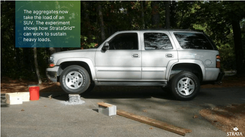
Geogrids are utilized in civil engineering projects intended for soil stabilization and erosion control. Geogrids are a natural solution and an inexpensive option for subgrade development when dealing with the natural challenges associated with land construction. Civil engineers must consider various factors depending on the land that is being developed. At Strata Geosystems, we are committed to providing assistance throughout the planning and consultation process.
Some common applications of geogrids are:
1. Embankments over soft soils:
Geogrids are used to provide reinforcement and stabilisation for embankments built over soft soils. By stabilising the subgrade, confining it, they minimise lateral movement and provide strength and better load bearing to weak soil areas.
2. Soil mass stabilisation:
Geogrids provide structural reinforcement to the soil mass on a slope, enhancing overall stability and enabling the safe construction of steep and durable structures.
Uses of geogrids in civil engineering:
Geogrids are chosen for their structure in construction and due to their unique properties. Principally working to stabilize or reinforce soil, geogrids are used in different industries.
What are construction projects completed by Strata Geosystems using geogrids?
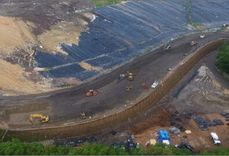
1. Egg Harbor Township, New Jersey, USA:
Strata Geosystems was involved in a project at the Atlantic County Utilities Authority (ACUA) landfill in Egg Harbor Township, New Jersey. The project focused on the vertical expansion of the landfill to accommodate more solid waste over the next twenty years. Strata’s solution was to build a peripheral Mechanically Stabilised Earth (MSE) berm outside the current berm to raise the height of the landfill. This new way enabled waste capacity expansion without increasing the landfill footprint. Strata also proposed using reclaimed asphalt pavement (RAP) and StrataGrid master rolls to ensure a flexible and stable structure, capable of withstanding differential settlement.
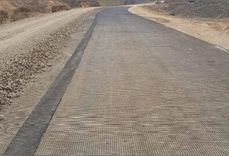
2. Kohima Bypass Road, Nagaland:
Strata Geosystems was involved in the implementation of a durable and flexible pavement solution using StrataGrid biaxial pavement. The objective of the project was to resolve the issues of building a high-traffic way in the hilly & remote areas of North-East India. The solution in this case was opting for StrataGrid biaxial instead of traditional methods because it helps decrease pavement thickness, lowers the consumption of natural materials, and reduces maintenance intervals.