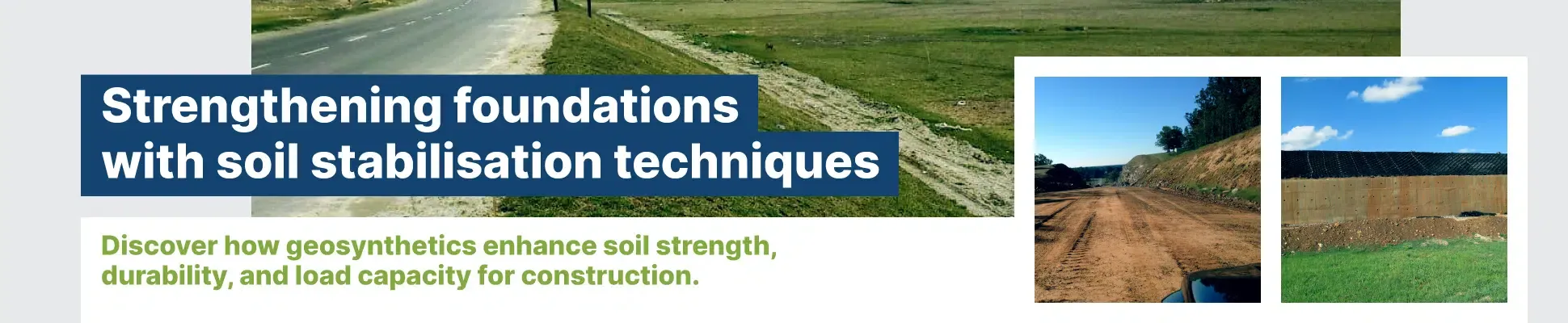
Soil stabilization alters the physical, chemical, or biological properties of soil to improve its stability, shear strength, load-bearing capacity, and geotechnical features for construction use. Soil stabilization, a branch of geotechnical engineering, improves soil properties by altering its physical, chemical, and biological characteristics. This is done by reducing permeability and increasing its overall strength before construction commences.
What are the common methods of soil stabilization?
Soil stabilization is broadly classified into three types, which we detail below:
- Chemical stabilization: Stabilization method that involves the addition of secondary materials or components to an existing substrate. This is done to change the density and ability to support weight. Materials such as Portland cement, sodium chloride, lime, polymers and others are used to alter the structure of the soil. The purpose of doing so is to make the soil more dense and less permeable.
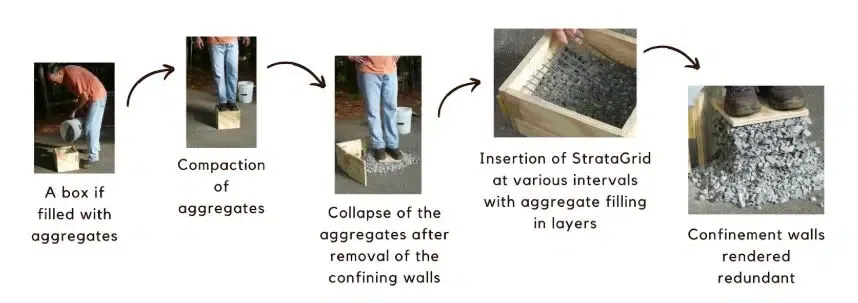
- Mechanical/ Physical stabilization: Mechanical stabilization physically modifies the soil through compaction, preloading, soil replacement, and reinforcement. These mechanical methods include compacting, preloading, soil replacement and reinforcement. The purpose of this kind of soil stabilization is to increase the density of soil particles and improve its load-bearing capacity. While traditional methods of mechanical soil stabilization can be resource intensive, the ready-to-use and ease of installation of various geotechnical products such as geocells, geogrids, geomembranes or geocomposites make them an easy-to-use soil stabilization tool.
- Biological stabilization: Biological stabilization uses natural processes, such as planting vegetation, to improve soil stability through root systems. These processes include planting vegetation to stabilize soil through root systems. The logic behind this is that roots help to hold the soil together. This helps in reducing erosion and improving the stability of soil particles. Soil properties can also be improved by microbially induced precipitation.
What is the purpose of soil stabilization?
Soil stabilization aims at enhancing the engineering properties of soil, and rendering it usable for civil engineering needs such as creation of roadways, mining, building bridges, canal draining, or even landfill management. The need for soil stabilization is broken down into five key geotechnical aspects.
- Enhanced mechanical strength: Improving the interlocking between soil particles, it improves the soil’s shear strength and load-bearing capacity, resulting in a more stable foundation. Geocells confine soil and redistribute loads, making them particularly useful in weaker subgrades and challenging terrains.
- Reduced permeability: Stabilizing soil helps reduce its permeability, limiting the flow of water through the soil mass. This is beneficial in areas where excessive water flow could lead to erosion, instability, or other geotechnical issues. Consider areas prone to excessive rain, where waterlogging causes roads to cave in. Geocells, typically filled with permeable aggregate, improve structural stability while maintaining or improving drainage, allowing water to pass through freely.
- Improved compressibility: Stabilization of road soil improves its compressibility, which is crucial for load distribution during construction and over the lifespan of the structure. This helps minimize settlement issues, ensuring the long-term stability and performance of the engineered structure. Soil compaction expels air and water from voids, reducing the soil’s volume and increasing its density. This process reduces future settlement, thereby preventing paved roads from cracking or caving in. The addition of a geogrid, for example, not only affects the shear strength of the soil during the subgrade improvement stage, but also positively influences the soil compression curve for soil types.
- Durability: Geosynthetics enhance soil resistance to environmental factors and loads, lowering maintenance costs throughout the structure’s lifespan.
- Plasticity: It reduces or controls the soil’s plasticity. By lowering the plasticity index (especially in clays), the soil becomes less susceptible to changes in water content, improving its workability and long-term stability. Geocells physically confine the soil within their cells, limiting its ability to deform and reduce plasticity, and therefore are an ideal supplement to soil subgrade improvement measures.
Common types of soil requiring stabilization
If you want to construct strong foundations and infrastructure it is important to understand what types of soil require soil stabilization. Below we have listed the kind of soils and the methods that are employed to stabilise them.
- Clayey soil: Clayey soils retain water, impacting their plasticity, shear strength, and compressibility. These factors lead to settlement and instability. As a result, clay is prone to expansion during monsoon and contraction during dry periods. This is where geogrids come in with improving localized stress concentrations, confinement of soil, and minimizing deformation. With an improved ability to resist deformation, and lateral movement, geogrids improve the California Bearing Ratio Value, bringing structural integrity to the layers as a whole.
- Sandy soil: Sandy soils have a low force of cohesion. This makes them more susceptible and prone to erosion and compression. While sandy soils have better drainage and higher shear strength compared to clayey soils, they do need reinforcement. A common challenge with sandy soil is its susceptibility to erosion. This is ideally managed using geotextiles (for filtration and separation) or geocells (for surface confinement). Geogrids primarily provide reinforcement against tensile forces and improve load distribution rather than directly preventing surface erosion. Since the chief role of geogrids is to manage and evenly distribute loads, due to the juncture strength, it works to protect sand against erosion, settlement. For example, especially ports tend to suffer with a mix of clay and sandy soil while needing strong load bearing capacities for containers. Here, complete geotechnical solutions are useful – right from subgrade improvement, load support, to lining surfaces for improved life of the port area.
- Silty soils: One of the most challenging soil types, but also found in areas which need roads and bridges, silty soils are found near river beds, with historic sedimentation. Since they contain deposits, they have low permeability, very high plasticity, low cohesion leading to compaction issues, and high chances of erosion. This soil is the biggest contender for soil stabilization and use of geogrids as they typically address all of these issues. From geocells, geomembranes, to geogrids – a wide suite of products can meet the industry specific applications for soil improvement.
- Peat soils: Peat soils decompose rapidly, making them prone to settlement and waterlogging. Their porosity results in poor load-bearing capacity, high compression, proneness to settlement, and waterlogging. It’s one of the terrains needing the most amount of soil stabilization which is non-chemical. Normally, stabilization methods like incorporating inorganic materials can highly improve their performance. While the stabilization needs will vary depending on the topography, and the geo-technical application, the typical application for soil stabilization comes with wetlands. While India has low incidence of such soil types, projects needing work in Kerala backwaters, Brahmaputra basin would need geosynthetic interventions for soil stabilization.
- Loamy soils: Loamy soil, a mix of clay, sand, and silt, is often favored by geotechnical engineers. Thanks to the composition, it’s moderately stable when compared to other soils. However, if they are subjected to extreme moisture fluctuations, they can have adverse responses. Depending on soil mix ratio, the shear strength may vary and as a result the soil stabilization technique needed will also change. Since it’s sensitive to moisture content, load bearing capacity is the most important challenging aspect of soil stabilization that needs to be addressed in the long run.
Geosynthetics- based soil stabilization
Geosynthetic products are made of durable polymers, most commonly polyester (PET), polypropylene (PP), and high-density polyethylene (HDPE). Geosynthetics are preferred in soil stabilization owing to the high tensile strength of the products.
- Geogrids: Geogrids are geosynthetic materials whose function is to provide reinforcement to the soil. These are made of high-density polyethylene or polyester. They provide high tensile strength to the soil and are used in areas that have poor soil conditions.
- Geotextiles: Geotextiles are another commonly used type of geosynthetic material that is used in soil stabilization. They are put to use because they improve soil drainage and reduce soil erosion.
- Geomembranes: Geomembranes are used in soil stabilization because they provide a barrier against water and other liquids. These are usually made of high-density polyethylene (HDPE) or synthetic materials. Their main function is to prevent the water from seeping through the soil.
- Geosynthetic clay liners: Geosynthetic clay liner is another type of geosynthetic material that is used in a number of construction sites. These are made of bentonite clay sandwiched between two layers of geotextile or geomembrane. Areas having high water content use geosynthetic clay liners.
How to choose the right material for soil stabilization?
Picking the right materials for stabilizing soil can be a difficult task. It forms an important part of construction projects. The first step is testing the soil to check its composition, and other properties before arriving at various steps of addressing the topographical challenges. For soil stabilization, StrataGrid uniaxial (SGU) geogrids are a popular choice of material. This is due to its high tensile strength and durability. Made of high-density polyethylene (HDPE) or polyester, geogrids are useful in areas that have poor soil conditions. They are easy to install and significantly reduce construction cost. Strata Geosystems is a popular choice of engineers who are looking for geogrids and if you would like to consult with us, we’re just a call away.
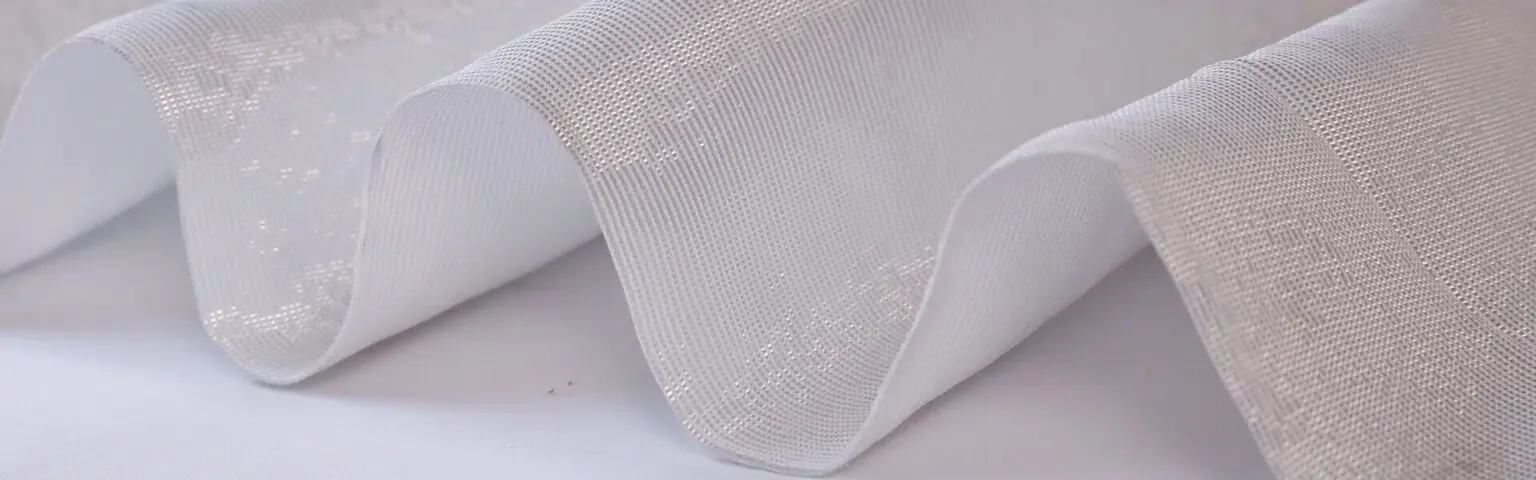
Geotextiles are another popular and multifaceted choice for stabilization among engineers who are looking for geosynthetic-based soil stabilization materials. Geotextiles improve drainage and reduce erosion in areas with high water content. Geotextiles perform three functions—separation, filtration, and reinforcement; making them a unique geotechnical product.
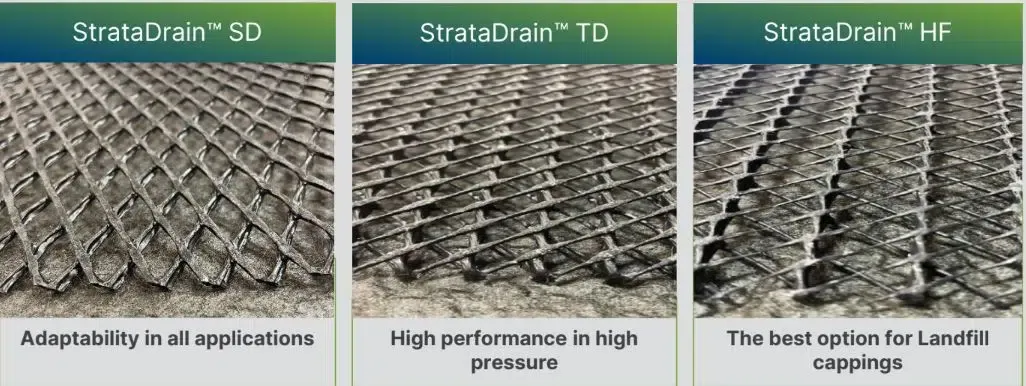
StrataDrain is often the choice for projects due to its ability to work in different environments, be it aggressive Ph, or aqueous environments. A high performance drainage composite product, it’s a non-woven geotextile that functions both as a separator and filter. It’s composed of high flow, geonet-geotextile drainage composites manufactured with high-density polyethylene (HDPE) geonet and polypropylene nonwoven fabric bonded to one or both sides.
As a result, it allows for liquid and gas –both to pass into the geonet core. This geonet in turn collects and allows the flow of liquid and/or gas into a collection system. With a width of upto 3.8 m, laminated in PP geotextile varying from 90 gsm up to higher weights, on one or both sides – StrataDrain’s properties make it a versatile product for soil stabilization in a wide range of soil types and are an excellent choice for your next project. Choose from different types, and consult with us for more insights on how we can design and implement your next engineering challenge.