
Meaning of slope stability
The stability of slopes is very important in any construction on hilly grounds whether it is a road or railway, building foundation or a large dugout. It refers to the situation in which a slope remains intact without any failure or collapse. It is a critical aspect of geotechnical engineering, as understanding and maintaining slope stability is essential for the safety of infrastructure and the prevention of landslides, which can cause significant loss of life and property damage.
Types of slopes and soil properties
- Natural vs. man-made slopes: Natural slopes, such as hills, take centuries to develop and are formed through geological processes, primarily uplift and erosion whereas artificial slopes are the result of earthworks or construction practices. Evaluation of both types is necessary as the soil and rock compositions vary greatly.
- Soil types and composition impact on stability: The composition of the soil affects the stability of a slope considerably. Coarse-grained soils, such as sand and gravel, are mostly well-drained and provide more stability, whereas fine-grained soils, especially with a lot of clay, are more easily saturated and displaced.
Environmental and external influences
- Role of water content and saturation levels: Water is one of the major environmental factors that influence the stability of a slope or embankment. Increased water content can initially stabilize a slope by raising the angle of repose; however, excessive saturation can lead to decreased stability as water acts as a lubricant, facilitating detachment and mass wasting events<u>.</u>
- Seismic activities and their effect on slope integrity: This state of slope stability is of interest in the regions of active faulting because stability considerations must also take into account during rapid changes in the state of the soil.
- Vegetation cover and its impact on soil reinforcement: Vegetation contributes to slope stability by enhancing the shear strength of the soil through root systems that bind the soil together. Plants like deep tap roots will aid in keeping soil stratum together, and preventing them from moving away.
Slope stability analysis methods and techniques
Limit equilibrium analysis (LEA)
Limit Equilibrium Analysis (LEA) is one of the primary methods used in evaluating the stability of slopes. This technique calculates the *Factor of Safety* (FoS), which is the comparison between forces resisting those driving a slope to instability. FoS values higher than 1.0 indicate stability, with any values below this threshold suggesting a greater potential for failure.
LEA assumes the soil behaves as a rigid body after failure, and it typically utilises the Mohr-Coulomb criterion to determine the soil strength. It is too simplistic in the presence of richer soil behaviors and not versatile enough for a complex geometry or layering of soils.
Limit Equilibrium Analysis, or LEA, is a common approach with applications in the evaluation of how stable a slope is. It is a technique whereby the activities of an engineer are directed at determining the Factor of Safety, FoS, which is the ratio of resisting versus driving forces.
- Application of factor of safety (FoS): The Factor of Safety is a key measure within LEA, representing the balance between resistance and movement. A higher FoS indicates a safer slope, with sufficient resistance against sliding.
- Key assumptions and limitation: LEA assumes that the soil mass behaves as a rigid body during failure and also that soil behaves as an idealised material, often characterized by a Mohr- Coulomb failure criterion. However this method has some limitations like oversimplification of soil behaviour, inability to handle complex geometries etc.
Finite element method (FEM) for slope stability
The Finite Element Method, FEM provides more detailed analysis of slope by giving importance to the relation of stress to strain in the soil. LEA assumes the soil to be rigid; thus, FEM does not assume such conditions, thus significantly evaluating deformation, plastic flow, and variable properties in soil. This interaction of complex models with conditions simulates the behavior of slopes much more closely under different conditions of construction.
Shear strength reduction (SSR) technique
A decrement technique of Shear Strength Reduction (SSR) is utilized in FEM simulating incremental degradation of soil shear strength until slope failure occurs. More importantly, for complex terrains, this method yields critical failure mechanism details through step-by-step degradation of shear strength, indicating where and how slopes are most sensitive to failure.
Benefits of SSR in complex terrain analysis: By simulating shear strength reduction, engineers get a clearer sense of what might trigger slope failure, offering an extra layer of safety for critical projects.
Methods to improve slope stability
Mechanical slope stabilization techniques
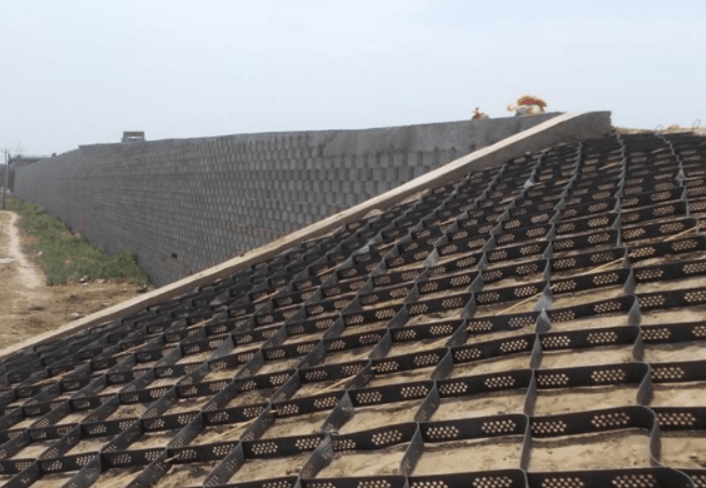
- Use of geosynthetics (Geogrids, Geocells) in reinforcement: Geosynthetics; geogrids and geocells make a contribution to improve slope stability through soil reinforcement. The cellular containment that is made possible by geocells retains soil and prevents lateral displacement; it proves advantageous in loose soils. In contrast, geogrids, with their open-grid structure, enhance soil shear strength by interlocking with adjacent soil, thereby fortifying the slope.
- Retaining walls and reinforced soil slopes: Retaining walls definitely support slope stabilization as it provides structural resistance against soil surcharge due to displacement. A composite structure with high shear strength and flexibility, reinforced soil slopes have layers of soil and geosynthetics, making them suitable for steeper environments with high stress.
- Soil nailing and its advantages in steep slopes: Soil nailing works well for both steep and vertical surfaces. By inserting metal or fiberglass rods (known as nails) into the soil, the slope is further reinforced.
Drainage and hydrological control techniques
- Surface drainage vs. subsurface drainage solutions: Surface drainage channels or gutters divert rainwater to prevent infiltration into a slope. Subsurface drainages of perforated pipes consider groundwater by lowering saturation levels in the soil, which reduce pore water pressure and enhance stability.
- Drainage pipes and their role in reducing water pressure: These pipes help reduce hydrostatic pressure on sloped regions by displacing surplus water. This still reduces the weight of soil but also reduces stress on retaining structures. Therefore, it assists to gain more stability of steep, saturated slopes.
Vegetative and biotechnical stabilisation methods
- Role of deep-rooted plants in slope reinforcement: Such plants with deep-rooted systems may well anchor soil layers, thereby improving slope stability by enhancing soil cohesion and resisting erosion. Soil is bonded together through plant roots, which prevent it from being displaced and allow natural reinforcement.
- Bioengineering solutions for erosion control: Bioengineering provides erosion control using engineered structures along with vegetation. The introduction of plants and their root systems that are appropriate to the slope’s soil conditions and climate lead to reduced surface erosion, increased water uptake, and, consequently, long-term stability.
At Strata Geosystems, we appreciate the meaning of every slope design as the integration of nature and structure. If these activities are done in a careful manner and the landform is respected, then projects will last longer and will be able to have a strong foundation even in the coming years.