
The concept of pull-out resistance plays an essential role in geotechnical engineering and construction projects. It determines how well geosynthetics and soil anchors stay firmly lodged under tension. Proper pull-out resistance is vital for ensuring the safety and stability of structures as it assists in the prevention of failures and thereby structural integrity. It is important to consider pull out resistance in projects which involves soil reinforcement, retaining walls and slope stabilisation.
What is pull-out resistance?
Pull-out resistance is defined as the amount of force required to remove a geosynthetic material or anchor from the surrounding soil. It is usually measured as force per unit length (kN/m). Pull-out-resistance is influenced by several factors. They are:
- Geosynthetic material [eg:Geogrids, Geotextiles, Geocells]
- Soil characteristics [eg: grain size and density]
- Environmental conditions [eg: temperature, moisture content]
- Embedment depth [The depth of the material’s installation]
- Degree of saturation [Moisture content of the soil]
Role of pull-out resistance in geotechnical application
Anchors are the versatile ground embedded devices to prevent horizontal movement by withstanding uplift and lateral forces. The pull out resistance of anchors have different resistance characteristics depending upon the factors listed below:
1. Type of anchors:
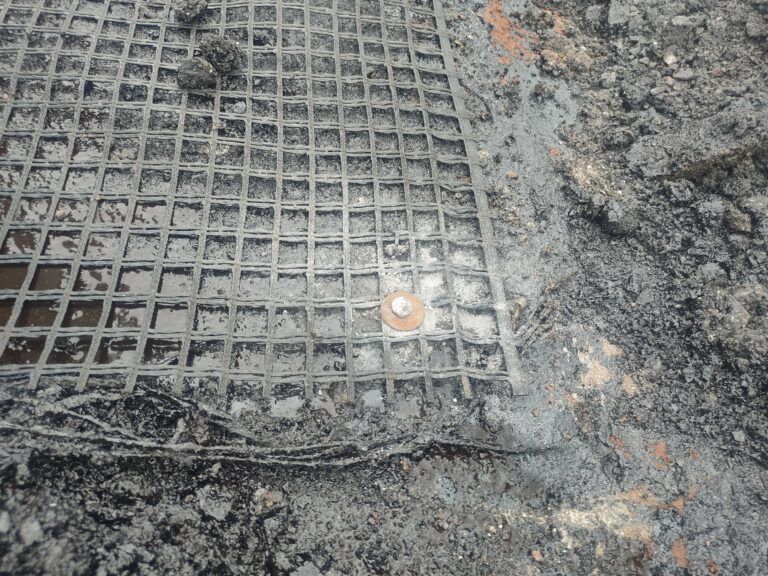
- Mechanical anchor: Used for soil stabilization and reinforcement
- Concrete anchor: Due to their high mass and surface area, it has stronger resistance and used in heavy duty applications
- Bolt anchor: Used in hard soil conditions
- Strap anchor: Used in temporary installations and rely on high tensile strength
- Ground anchor: Used in soil reinforcements and slope stabilization.
Each anchor type varies in terms of resistance based on factors such as material composition, weight, and installation depth. For example, concrete anchors have stronger resistance due to their mass, making them ideal for retaining walls and other structures subjected to high loads. In civil engineering, the pull-out resistance of geosynthetics (e.g., geogrids, geotextiles) is critical for soil reinforcement, slope stabilization, and landfill containment. The factors influencing this resistance include:
- Soil type: Compact, granular soils provide better resistance than loose or soft soils.
- Friction coefficient: The friction between the geosynthetic material and the surrounding soil directly impacts its pull-out resistance.
- Installation method: Proper embedding and installation techniques significantly enhance pull-out resistance.
Applications of pull-out-resistance
The concept of pull- out resistance is widely used in various fields like civil engineering, construction, agriculture etc. It helps in the selection of perfect materials and connectors which allows for improved design and thereby, more proven outcomes. In civil engineering, it plays a vital role in projects such as:
- Retaining walls: Pull-out resistance ensures that soil reinforcement systems resist lateral pressures.
- Slope stabilisation: Geosynthetic materials used for slope stabilisation must have high pull-out resistance to prevent landslides.
- Road and bridge construction: Ensures infrastructure stability in embankments and foundation systems.
What are pull-out tests?
The pullout test is the most common experimental method of geosynthetic design to comprehend pull -out resistance under various controlled conditions. The test is relatively simple, cost-effective and also feasible. This test examines the friction between geosynthetics and the surrounding reinforced soil composition. These tests help the engineers with safety assurance, quality material selection, design validation and quality control. Two primary testing methods used to measure the pull-out resistance are Laboratory tests and field tests.
Laboratory pull out tests
In laboratory settings, soil samples are placed in a controlled environment to measure the pull -out force of the specific soil conditions. The method enables detailed governing of the soil conditions like moisture and compaction to study their consequence on pull- out resistance. Usually, the laboratory installation includes a large pullout box, a sleeve, a clamping system, a servo hydraulic control system and a set of external transducers. Various types of laboratory pull-out tests includes,
- Direct pull-out-test: Measures the force required to pull a geosynthetic out of the soil under various conditions.
- Adhesive bond pull test: Focuses on adhesive interactions between the soil and geosynthetics
- Cyclic pull out test: Measures the impact of repeated pull-out cycles on resistance.
- Shear pull-out-test: Examines the shearing resistance at the soil-geosynthetic interface.
- Embedded-anchor pull-out tests: Assess the anchorage capacity to prevent the anchor-pull-out failure.
Field pull out tests
The pull -out force is measured directly in field settings and used to measure the performance of anchors, piles and soil nails in real world conditions. These tests help to interpret the working of various installation methods under actual loads and environmental circumstances. Common methods of field pull-out test are :
- Portable pull-out testing
- In-situ pull out tests
- Plate load test
- Dynamic load tests
In both these tests, compressed stress is applied to the top soil layer and horizontal force to the geosynthetics and the force required to pull out the geosynthetics and anchors out of the soil is captured. Usually, larger specimens have higher pull- out resistance.
Pull-out-resistance of geogrids
Geogrids are the most widely used geosynthetics for soil reinforcement, erosion control, soft soil embankments and for enhancing stability. Pull out resistance of geogrids is composed of skin friction on the surface of the geogrid ribs and bearing resistance deployed against the transverse members. Their pull-out resistance is influenced by
- Surface roughness: Rougher the surface, the more cohesive the soil and thereby better pull-out-resistance.
- Embedment depth: If the geogrid is concealed deeper, it results in higher pull-out-resistance.
- Aperture size: Larger apertures provide better interaction with soil and help to amplify the friction and resistance.
These characteristics make geogrids highly effective in soft soil embankments and retaining walls, where they offer enhanced stability and reduce the risk of structural failure.