
What do paved roads mean?
Paved roads are the most common engineered surfaces created using materials like asphalt or concrete designed to provide better transportation facilities. Paved roads withstand heavy loads and reduce the wear and tear on vehicles leading to increased mobility. Today, approximately 94% roads utilize asphalt, a testament to its cost-effectiveness and adaptability to diverse climates and traffic conditions.
Types of paved roads
Paved roads can be categorized based on the materials used and the specific functions they serve. The three primary types of paved roads are:
- Asphalt roads: Asphalt roads are human-made structures formed by mixing asphalt along with aggregates, one of the most widely used materials for road construction owing to its heavy performance capacity against load alone and it is very effective for harsh climate environments. This property makes them flexible and they can handle the temperature fluctuations, letting them avoid cracking, which helps with durability. The strength and cost-effectiveness of asphalt make it a popular choice for residential driveways, commercial parking lots, and high-traffic thoroughfares. Asphalt is one of the most inexpensive options, easy to repair, and providing a quieter ride than other paving techniques.
- Concrete roads: Concrete roads are constructed using aggregate along with cement. Concrete roads are durable, safe and less prone to wear and tear defects like rutting, cracking, stripping loss of texture that can occur with flexible pavement surfaces. While concrete may involve higher initial investment costs, it offers remarkable longevity and is often used in highways and high-load scenarios.
- Composite roads: Composite roads are constructed of multiple layers of both asphalt and concrete to enhance performance and durability. These types of roads are also known as asphalt- concrete overlay. Concrete layer provides structural capacity while an asphalt surface layer provides wearing surface course. Such roads are best suited for heavy traffic areas because they can manage both load and temperature fluctuations effectively.
Materials used in paved roads
- Bitumen: Bitumen is a semi-solid binding agent used for holding asphalt together. Bitumen is an excellent water-resistant component and engineers often use it for waterproofing because of its high viscidity. This liquid adhesive is often confused with asphalt.
- Cement: Cement is a binding agent made from limestone and clay. Cement when mixed with aggregates produces mortar and when mixed with sand and gravel, produces concrete. Cements can be either hydraulic or non-hydraulic.Portland cement is widely used for it’s strength and quick setting properties.
- Aggregates: Aggregates are inert granular materials including sand, gravel, crushed stone, slag and geosynthetic aggregates. These along with Portland cement and water are considered as an essential element in concrete. They are divided into two groups by size, as coarse aggregate and fine aggregates. Aggregates increasing the volume of concrete leads to reduced cost and they serve as a reinforcement to add strength to the composite material.
Factors affecting paved roads
- Traffic load: Wheel load on pavements affects the stress distribution and deflection within a pavement. The damage to the pavement will also be much higher if the vehicle is moving at creep speed. The increase in truck volume and heavy axle loading reduce the structural capacity of roads leading to deformation and premature failures.
- Climate and environmental conditions: In paved roads, temperature affects the resilient modulus of asphalt layers . They lose their stiffness during hot conditions and become brittle at low temperatures. Temperature also induces curling of the concrete slab. Colder climates cause frost and ice to penetrate the pavement which leads to stress and saturation in the subgrade, reducing the subgrade strength.
- Maintenance and repair interval: Road surfaces will suffer degradation over time from both traffic and environmental factors. The maintenance of roads constitute a significant financial burden for local governments. The costs associated with paved roads are substantially higher than those for gravel roads. Paved roads require regular pavement monitoring to preserve user’s accessibility and safety. Regular maintenance tasks, such as filling cracks, potholes, and seal coating, are essential to prevent minor issues from escalating into major repairs
Difference between paved, unpaved and surface roads
| Paved roads | Unpaved roads | Surface roads |
|---|---|---|
| ● Made from materials like asphalt or concrete. | ● Mixture of gravel placed and compacted on finer grained soils such as clay or silt. | ● Roads with gravel surface, chip seal or tarmac |
| ● Hard smooth surface | ● Low visibility | ● Includes both paved and unpaved roads. |
| ● High durability | ● Moderate durability | ● Less durability |
| ● Environmental friendly | ● Lower initial cost | ● Require more pothole maintenance |
| ● Improved traffic flow and safety. | ● Higher maintenance needs. | ● Does not contain any hard protective layering |
| ● Leads to significant ecological degradation. | ● Reduced environmental footprint. | |
| ● Lower maintenance | ● More susceptible to damage from rain and snow. | |
| ● Minimizes dust production |
Paved road construction process
Modern construction techniques incorporate prefabricated rigid layers, which streamline installation and enhance structural longevity. This method allows for quicker construction and maintenance of pavements, minimising material consumption and carbon emissions.
- Site preparation: Vegetations, trees and debris are removed and some materials are recycled for use in erosion control measures. A crucial step is “cut and fill” which involves precisely grading the land. This approach minimizes construction labor and conserves excess material, reducing soil disposal. Sloping is also crucial and when preparing an existing land, potholes and rust are filled up as necessary
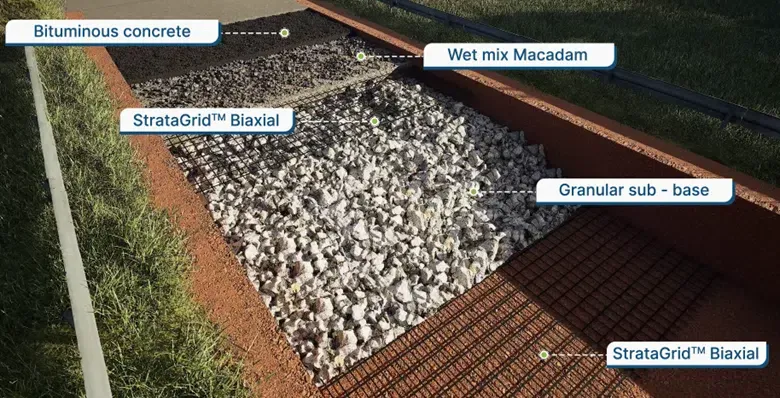
- Pavement layering techniques: There are two types of pavement used in the road construction process. Flexible pavements and rigid pavements. Usually flexible pavements require the subgrade course ( lowermost), sub-base course, base course, prime coat, binder course, tack coat and surface course (topmost) and is primarily constructed of bitumen or asphalt. On the other hand, rigid pavements are constructed from Portland cement and consist of three layers, including subgrade, base course and surface course. These have high rigidity and flexural strength.
- Paving techniques: One of the most common techniques is Hot Mix Asphalt(HMA) which involves mixing asphalt binder with aggregates at high temperature. There is also a thin overlay system, where a thin layer of asphalt is poured over an existing surface to improve ride quality. Others are concrete paving, interlocking pavers, stabilised base layers, microsurfacing etc. The paving process employs various specialized tools and equipment, such as pavers, rollers, rakes, tampers, and screeds.
Paved roads provide a durable and smooth surface that encompass a wide variety of vehicles and withstand high traffic volumes, making them essential for urban infrastructure. Concrete pavements also do not produce any environmental pollution. Paved asphalt roads prevent road accidents by lessening splash spraying on tires during the rainy season. They are also less prone to dips and rutting.