
The importance of geosynthetics installation
Effective geosynthetic installation is the systematic and careful process of deploying geosynthetic materials in civil engineering projects. Notably, improper installation techniques lead to significant issues, including structural failure, reduced efficacy of drainage systems, and environmental hazards. Hence proper installation guarantees the efficiency and longevity of geosynthetics, thus safeguarding the investment and the ecological balance.
Pre-installation considerations for geosynthetics
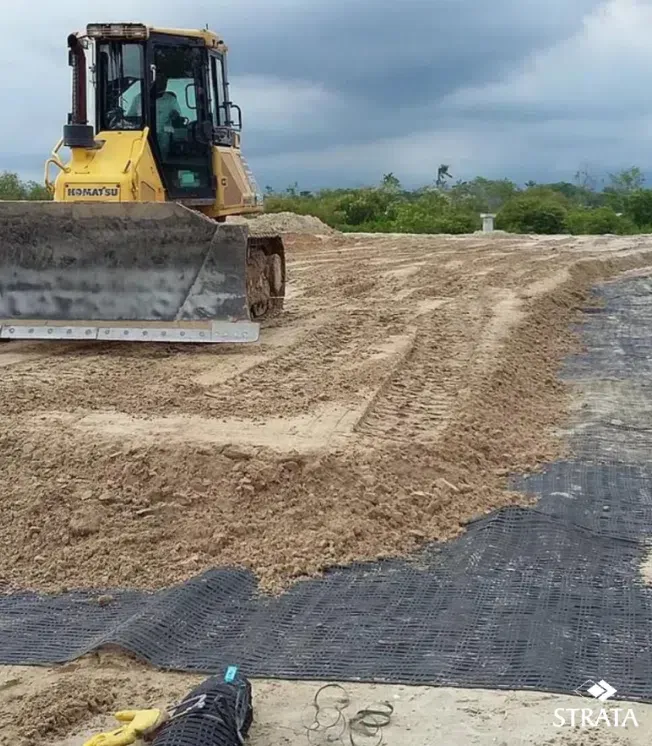
We at Strata global consider that before any item hits the ground, one must make the necessary arrangements. Several important aspects must be taken into account.
- Site Assessment: The first concept is site understanding. The geomorphology, temperature variation, and moisture content of the soil are attributes that will affect the use of geosynthetics in the site.
- Material Selection: Only geosynthetics should not be generalized for every purpose. The suitable material for the application which could either be geogrids, geocells, or geotextiles would lead to the best possible result.
- Surface Preparation: It is necessary to prepare the ground prior to arrangement of the geosynthetics. The surface must be without any dirt, sharp-ended stones or rough patches.
- Geosynthetic placement: The orientation and arrangement of geosynthetics is important. A wrong positioning compromises the efficiency of the material.
- Geosynthetic securing: Proper anchoring is very important. In the absence of secure placement, materials are able to displace after a certain time.
- Sealing overlaps: There is a need to ensure that all the overlaps between the respective sections have been securely sealed.
- Covering with soil: Once the geosynthetic has been placed, it’s confined and the effect of the elements are minimized. Then the next thing that follows is placing soil or other protective cover over the geosynthetic.
Special techniques for different geosynthetics
The installation techniques of various geosynthetics differ from each other.
- Geogrids: During the installation, they must be installed and tensioned accurately so that they stabilize the poor constituent soils and ensure soil compaction.
- Geocells: Are ideal for soil containment due to their cell like designs. And it is important to ensure that the surface is properly graded and leveled.
- Geotextiles: These are often used for filtration and separation, therefore, maintenance and care must be taken during installation to avoid wrinkles or excessive tension.
- Geocomposites: These systems consist of multiple layers that offer the properties of various materials and are rolled out on the prepared subgrade.
Challenges faced during installation
The applications of geosynthetics often imply harsh environments but each endeavor has its own difficulties.
- Handling weather conditions: Weather can pose difficulty in the installation process. For instance, it may be difficult to secure the materials with the installation if there are high winds, while in the case of moisture, the ground is softened making it hard to establish the materials in the right way.
- Damage prevention: Geosynthetics are made from robust materials, however, they are also prone to damage. The presence of sharp stones when the material is being placed compromise the material making it ineffective.
- Dealing with slopes and uneven terrain: Challenges also arise because of dissimilar surfaces. In such instances, it becomes increasingly difficult to hold the material in place.
Post-installation steps
There are a few more factors that need to be looked into, to ensure that the system works well even in the long run.
- Inspection and quality control: Once the geotextile is installed, it is advisable to perform a thorough inspection again to identify any new issues that were not discovered in the first place.
- Covering and backfilling: After the geosynthetic has passed inspection, the next procedure is backfilling. It is the same as how the material is charged by using soil or other materials.
- Performance monitoring: Monitoring the performance of a system or component is necessary, even if all installation work is completed to minimize the risk of failure.
Common mistakes in geosynthetics installation
Geosynthetic installation is something that even the most seasoned crews may get wrong. In fact, avoiding such mistakes is vital for one to be successful.
- Improper overlay or seaming: Where there is an overlap that has not been insulated properly, a failure of the system is very likely to occur.
- Insufficient anchoring: There are chances that geosynthetics will move without the right anchoring in place.
- Failure to account for load distribution: In geosynthetics installation, it is pertinent to consider the load distribution of the structure.