
What is creep and creep strength?
Creep is referred to as a time-dependent deformation of a material under constant stress, particularly at high temperatures and creep strength is the ability of a material to resist gradual deformation or failure due to the sustained application of stress at high temperatures.
Creep strength is significant in geotechnical applications like slope stabilisation and retaining walls. The creep response is represented as strain versus time or log time curves, which typically display a non-linear relationship depending on the strain rate and material conditions.
Stages of creep
Interpreting the three stages of creep is vital for engineers to predict how materials will behave under long – term stress conditions:
- Primary creep:This is the initial stage when there is a rapid elongation of the specimen and is characterised by decreasing rate of strain with time. This stage is short compared to others.
- Secondary creep (steady-state creep): Also known as steady-state creep, this stage is the most significant in terms of material performance This eventually reaches a steady state in which the creep rate alters very little with time ie.constant strain rate. This critical phase is typically used to evaluate creep resistance in materials for long-term performance.
- Tertiary creep: During this final stage, the creep rate begins to increase rapidly leading to imminent failure due to fracture, rupture, or buckling.
Creep testing
A creep test allows engineers to design structures while understanding the relationship between stress, temperatures, and creep strength to ensure that a part will not fail at loads below its yield strength at elevated temperatures.While conducting the creep test, the specimen is subjected to elevated temperature conditions and loaded with a fixed tensile force or tensile stress. Stress relaxation tests determine the lessening of stress over time under constant deformation, simulating how a geosynthetic would function under sustained loads. Long-term durability testing in isolation typically simulates the effects of UV radiation, chemical exposure, and temperature changes on geosynthetics.
Factors affecting creep strength
Creep strength in geosynthetics is influenced by several key factors that regulate their long-term performance and durability in various soil-related structures.
- Temperature:Temperature is a significant factor affecting creep behaviour. The creep modulus, a measure of a material’s capacity to deform under a constant load over time, abates with increasing temperature. This means that at higher temperatures, a material will deform more easily under the applied load, indicating a reduction in creep strength.
- Polymer properties:The composition and structure of the polymer affects its creep resistance. Polyester-based geosynthetics tend to exhibit higher creep strength due to their crystalline structure and improved resistance to creep deformation compared to other polymers like polypropylene.The structure of geosynthetics—whether they are nonwoven, woven, or of integral design—also plays a critical role in determining their creep strength.
- Soil environment:The conditions of the soil environment, including moisture level, soil type, pH further influence the creep strength. Variations in confining pressure notably alter the creep response, particularly for non-woven geotextiles, where increased confining pressure leads to reduced total strain under load.
- Testing conditions: The environment under which a material is evaluated, including the method and duration of creep testing, the rate of loading and temperature control influence the measured creep strength.
- Loading conditions: The applied loading conditions, including the magnitude and rate of the load, are vital in assessing creep strength. A higher initial load typically leads to a greater immediate strain, while the loading rate influences the initial strain value and the rate of creep deformation over time.
Creep strength in geosynthetics
Creep strength in geosynthetics is a key property that refers to the material’s ability to resist time-dependent deformation under a constant load over an extended period. Creep strength is significant in applications such as reinforcement of soil structures, stabilisation, drainage systems, or geotextile applications in road construction. Geogrids and geocells are widely used to improve soil stability and their ability to mitigate soil creep is vital for ensuring the durability and safety of civil engineering structures. Unlike tensile strength, creep strength focuses on long-term performance under a constant load. In geosynthetics, a higher resilient modulus may correlate with reduced creep deformation over time, emphasising the need for comprehensive testing to fully assess material performance.
Creep strength of soil reinforced with geogrids
Geogrids are flat, grid-like structures made from polymer materials, such as polyester or polypropylene, which interlock with soil particles to create a mechanically stabilised layer. This structure enhances load distribution, allowing forces to be transferred across a wider area, thereby improving the load-bearing capacity of the soil and creep strength. The junction efficiency of geogrids is pivotal, particularly for applications involving the ‘confinement effect’. This characteristic is more critical for stabilisation applications than the tensile strength of the geogrid itself, as it influences overall performance in various loading conditions. The use of multiple layers of geogrids can significantly improve the load-settlement behaviour of foundations and slopes, thereby increasing safety factors in geotechnical applications.
Creep strength of soil reinforced with geocells
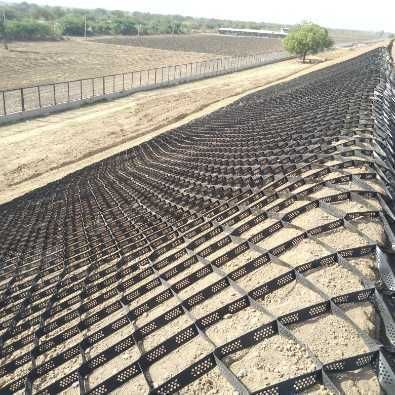
Geocells are three-dimensional honeycomb-like structures that confine and contain infill materials, which can be soils, aggregates, or other materials.
The rate and amount of creep strength increase with the applied load in soils reinforced with geocells. Geocells effectively reduce creep deformation in soils subjected to long-term loading conditions as the lateral confinement provided by geocells helps maintain the integrity of the soil structure, thereby limiting the volumetric changes associated with moisture content variations. Geocells provide greater support to the infill material and tend to distribute applied loads more evenly, leading to reduced creep effects compared to traditional soil without reinforcement.This property results in enhanced stability for slopes and embankments.
Applications of high creep strength geosynthetics
High creep strength geosynthetics are essential in numerous civil engineering applications.They are:
- Road and pavement reinforcement: Geosynthetics with excellent creep strength are used in pavement reinforcement to reduce rutting, cracking, and deformation over time. They enhance the lifespan of the road structure by distributing loads more evenly across the soil base.
- Retaining walls and embankments: In reinforced soil walls, geosynthetics with higher creep resistance are used to provide stability and avert long-term deformation under pressure from the soil and traffic loads.
- Landfill liners and covers: In landfill applications, higher creep strength prevents the leakage of hazardous materials, thereby preserving structural integrity and environmental conditions.
- Erosion control: Geosynthetics used in erosion control applications, like geotextiles and geocells, must exhibit long-term creep resistance to maintain the structure under the pressure of wind, water, and soil movement.
Creep strength and creep rupture strength
Creep strength is concerned with the material’s resistance to long-term deformation without excessive strain. It helps predict whether a material will exhibit acceptable levels of elongation over time during its service life. Creep rupture strength refers to the maximum stress a material can sustain under a constant load for a long period of time before it ruptures or fails due to creep deformation. It is an indicator of how much time a material can withstand a load before rupturing or breaking.
The importance of creep strength in geosynthetics cannot be understated. For civil engineering applications that require long-term durability and stability, geosynthetics with excellent creep resistance are essential, whether in road construction, landfill containment, or soil reinforcement. As infrastructure demands evolve, focusing on creep strength in geosynthetics will continue to be a key factor in developing reliable, and environmentally resilient solutions.