
Every successful soil reinforcement system begins with a fundamental principle—friction. At Strata Geosystems, we’ve spent decades refining how our geosynthetics interact with soil. Among the key factors to this interaction is asperity height—the small-scale surface roughness that controls how effectively the soil grips the geogrid, geocell, or drainage composite surface.
Whether it’s the steep containment walls of the Vapi Landfill, the green veneer over Ghazipur, or reinforced embankments along national highways, Strata’s control of asperity height directly influences how efficiently loads are transferred, slip is prevented, and long-term stability is achieved.
What is asperity height?
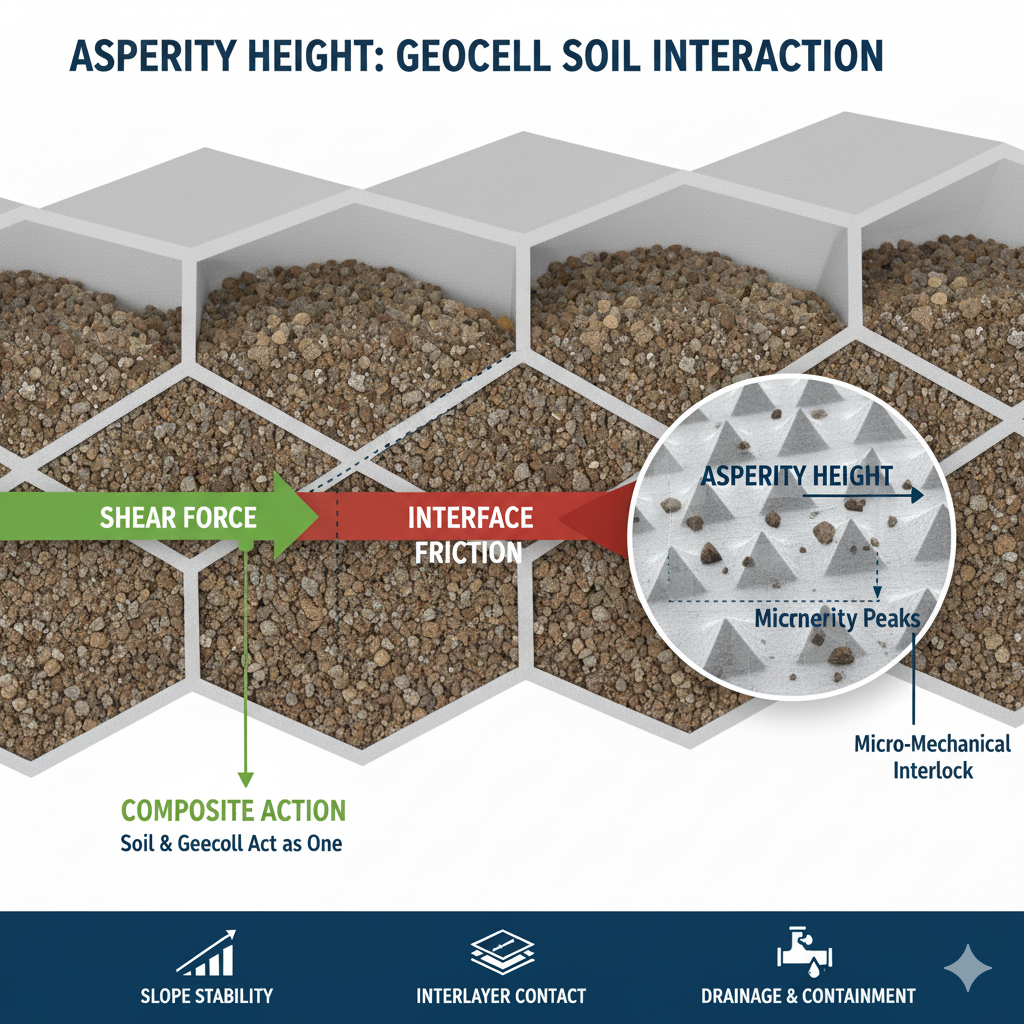
Asperity height is the amplitude of surface projections formed during the manufacturing of geosynthetics. In simpler terms, it’s the roughness you feel when you run your hand along a geogrid rib, a geocell wall, or a drainage core.
These micro-projections, or embossed features, create a textured surface that interlocks with soil particles. By increasing interface friction, asperities raise the interface shear strength and contribute to improved stability of the soil–geosynthetic composite. The magnitude of the benefit depends on asperity geometry, soil gradation and stress conditions, so product- and site-specific testing is recommended.
At Strata, this parameter is never random. It is controlled, measured, and validated through stringent in-house QA/QC programs accredited by GAI-LAP and NABL across our manufacturing lines. Each product—whether StrataGrid™, StrataWeb®, or StrataDrain™—is supplied with a specific surface profile that matches its intended interaction with soil or geotextiles.
Why does asperity height matter?
The performance of Strata’s reinforcement systems depends not only on tensile capacity but also on how the product interacts with soil. A geogrid or geocell with a smooth surface offers limited engagement under load; it can slip through compacted layers. The engineered asperities on StrataGrid™, StrataWeb®, and StrataDrain™ convert this interface into a frictional zone, mobilizing the full shear strength of the soil-geosynthetic system.
In drainage and containment systems, asperities improve interlayer contact and reduce shear displacement risk—helping maintain flow paths and reliable transmissivity when combined with correct lamination and installation.
Interface friction and stability
Increasing asperity height raises interface friction up to the design optimum, improving resistance to sliding when matched to the soil type. When the geosynthetic resists relative movement, the reinforced zone gains stability against sliding and deformation. In StrataGrid™ and StrataWeb® systems, the improved friction has consistently enhanced slope and wall performance under surcharge and seismic conditions.
Enhanced field bonding
During compaction, soil embeds into the textured surface, forming a micro-mechanical interlock. This interlock prevents local slip planes and enables the soil and geosynthetic to act as a single composite mass. The result is an increase in interfacial bond strength driven by both frictional resistance and mechanical key-in. The outcome is reliable load transfer and higher composite stiffness of the reinforced soil zone, leading to improved facing connection performance.
For landfill liners or capping systems, asperity height helps StrataGrid™ and StrataDrain™ maintain secure contact with geomembranes and geotextiles. This friction reduces the risk of slippage at smooth interfaces, helping leachate and gas collection layers stay aligned through settlement and wet-dry cycles. The result is consistent liner integrity throughout the landfill’s service life.
Safety and service life
Across projects like Vapi and Ghazipur, Strata’s asperity control has shown measurable improvements in safety factors against pullout and sliding—even under wet, cyclic, or seismic loading. By maintaining asperity height within tight design tolerances, Strata ensures the system’s interface strength remains consistent from installation through long-term performance.
Asperity height across Strata products
StrataGrid™ – high pullout resistance through controlled texture
Each StrataGrid™ rib carries a precisely engineered surface texture formed through Strata’s proprietary coating process. These asperities enhance soil interlock and transfer stresses uniformly across junctions. Field and laboratory tests have shown that this controlled texture delivers higher pullout resistance and superior interface shear strength compared to smooth grids, ensuring faster, safer construction and long-term wall and embankment stability.
StrataWeb® — embossed cell walls for soil anchorage
Each StrataWeb® strip carries an embossed texture that increases friction between the cell wall and the soil infill. This controlled asperity height enhances confinement and prevents soil slippage on steep or smooth geomembrane slopes. In projects such as Vapi and Ghazipur landfills, this micro-texture enabled stable, vegetated slopes that have remained intact through multiple monsoon cycles.
StrataDrain™ – textured ribs for stable interfaces
In StrataDrain™ composites, asperity height plays a dual role: ensuring intimate contact between the HDPE geonet core and laminated geotextiles, and maintaining friction against geomembrane surfaces in landfill and capping systems. The surface ribs of the geonet resist shear even under high normal stress, which preserves transmissivity and prevents clogging — critical for landfill capping and leak-detection layers.
StrataTex HSR™ – friction from surface yarn structure
The high-tenacity knitted polyester structure of StrataTex HSR™ produces a textured surface profile through its looped yarn architecture. This enhances interface friction when placed between soil layers or beneath aggregate in basal reinforcement. The low creep and consistent dimensional stability ensure that asperity contact is preserved even under long-term loading.
Factors influencing asperity height performance
Manufacturing process parameters
Strata’s controlled extrusion, embossing, and coating processes govern asperity uniformity and spacing. Each production batch of Strata Geosystems undergoes surface profiling to ensure compliance with internal design specifications.
Interfacing material
The efficiency of asperity engagement depends on the nature of the backfill type — granular, cohesive, or composite. For sands and gravels, deeper asperities improve interlock, whereas for silts or clayey soils, moderate roughness avoids void entrapment. Strata engineers evaluate soil characteristics during design to select the appropriate product and asperity configuration.
Material composition
PET, HDPE, and PP polymers behave differently under load. The stiffness, flexibility, and coating material influence how asperities deform or maintain shape during compaction. Polyester maintains its asperity geometry under long-term loading due to its low-creep, high-modulus behavior, whereas HDPE textures may experience minor flattening under sustained stress but offer excellent toughness and flexibility.
Asperity density
Not just height, but how many micro- projections per unit area affects frictional behaviour. Dense, evenly distributed asperities provide more uniform load transfer, reducing local stress concentrations. Strata’s testing labs determine the optimal spacing that maximizes soil engagement without compromising tensile properties or ease of handling.
Soil gradation and moisture
Well-graded soils develop stronger mechanical interlock with textured geosynthetic surfaces. Moisture content influences not only adhesion but also the effective stress and matric suction within the soil, which together govern interface shear strength.
Installation pressure and compaction method
Uniform compaction ensures consistent asperity engagement. Over-rolling may flatten microprojections, while under-compaction limits interlock development.
Practical insights from the field
- Match asperity profile to soil type. Coarse backfill needs deeper embossing; silty soils perform better with fine textures.
- Inspect textures on site. Handling or unrolling can sometimes abrade surface peaks—quick visual checks prevent compromised friction.
- Don’t ignore the compaction technique. Smooth-drum rollers tend to polish surfaces; pad-foot or static rollers maintain the intended interlock.
- Document shear test data. Every project that has included interface shear tests early has seen fewer construction surprises later.