
Anchorage systems connect structures firmly to the ground. They safely transfer tensile loads into soil or rock and keep reinforcements, facings, or structural parts stable when under tension. From retaining walls and embankments to tunnels, landfill cappings, and erosion control systems, the reliability of the anchorage has an important role in the long-term performance and stability of the structure.
Strata Geosystems applies field-proven anchorage solutions built from extensive project experience. Our designs are specified to provide predictable pullout capacity, long service life, and efficient on-site installation, reducing project risk and maintenance needs.
What is an anchorage system?
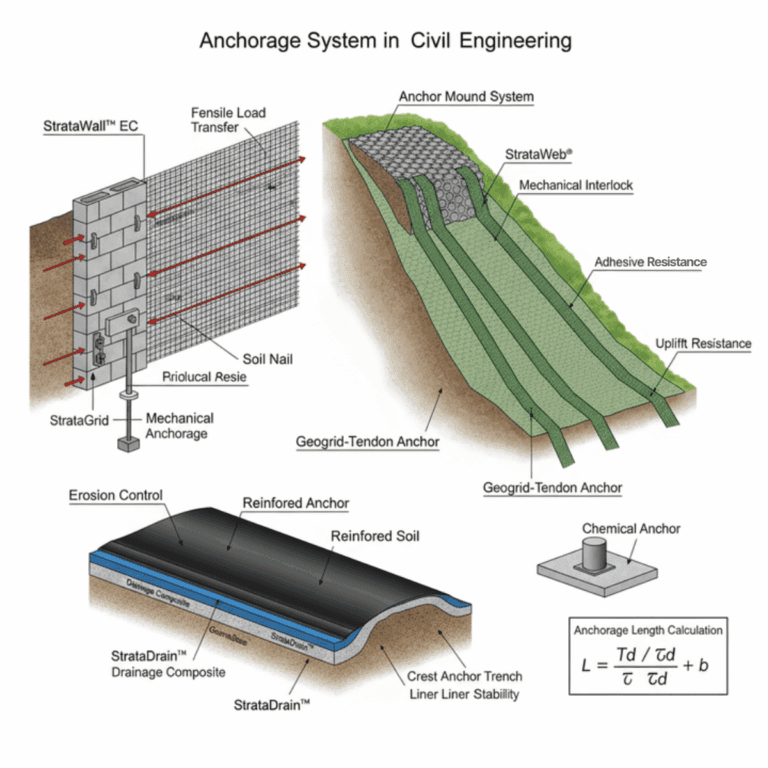
An anchorage system is a combination of structural and mechanical components that transfer tension or uplift forces from a connected element into a stable substrate- such as soil, rock, or concrete. It provides the connection that allows reinforcements—whether steel bars, concrete panels, or geosynthetics—to mobilize their full tensile strength while resisting unwanted movement. When combined with durable, low-creep materials such as polyester (PET), it also limits long-term deformation and withstands environmental effects over the structure’s life.
Anchorage performance depends on load transfer mechanisms such as:
- Frictional resistance (soil-reinforcement interface)
- Mechanical interlock (grids or ribbed surface)
- Adhesive bonding (chemical or grouted anchors)
In geosynthetics, this load transfer occurs through the interaction between the reinforcement and the surrounding soil—a process that must be quantified and validated during design.
Where are anchorage systems used?
Anchorage systems are integrated across a wide range of civil and geotechnical works:
- Erosion control: Anchorage systems secure StrataWeb® geocells and geotextiles on steep slopes and landfill caps. Crest anchors using trench systems or geogrid-tendon anchors resist uplift and hydrodynamic forces. One of the most challenging examples was the Ghazipur landfill in Delhi, where conventional crest trenches were infeasible. Strata engineers developed an anchor mound system that held geocells and geogrids in place over untextured geomembranes — a first-of-its-kind design that has withstood multiple monsoons.
- Reinforced soil retaining walls: In StrataWall™ EC and StrataBlock™ systems, anchor connections transmit loads from the facing panels to StrataGrid™ reinforcement layers. The mechanical connectors are engineered for durability, reducing long-term maintenance and ensuring stable load transfer even in aggressive environments. A detail often missed is the seating of connectors — ensuring intimate contact and proper tensioning during installation prevents wall deformation and differential settlement.
- Embankments and slopes: Anchorage maintains geosynthetic alignment in reinforced soil embankments and StrataWeb® slope protection systems. Strata’s design practice includes crest trenching, geogrid-wrapped soil berms, or deadman anchors, depending on slope geometry. The often-omitted factor here is anchorage pull-out capacity, which must exceed the geosynthetic tensile load derived from stability analyses – critical on soft subgrades or where uplift pressures exist.
- Tunnels and cuttings: In tunnel drainage and cut slope protection, StrataDrain™ composite systems are anchored to resist hydrostatic uplift and shear at interfaces. While most designs focus on flow transmissivity, field engineers recognise that anchorage spacing determines whether the drain composite remains bonded to the substrate under shotcrete or backfill loads.
- Drainage and containment systems: Anchorage secures geomembranes and drainage layers in leachate collection systems, preventing uplift during gas buildup or rainfall infiltration. At the Vapi landfill, Strata anchored StrataDrain™ and geomembranes using composite geogrid systems integrated with reinforced soil walls, maintaining integrity under significant internal pressures. A common oversight is failing to design anchors for gas venting scenarios, where pore pressure variation can lift the liner system.
- Ground improvement and foundations: Anchorage is critical in soil nails, tiebacks, and uplift anchors supporting deep excavations and bridge abutments. When used with StrataTex HSR™ or StrataGrid™, the anchors mobilize the full tensile resistance of the reinforcement, improving stability.
Functions of an anchorage system
- Transfer of tensile forces: Anchors move tensile loads from facing elements or reinforcements into the surrounding soil mass.
- Maintaining reinforcement alignment: Proper anchorage prevents misalignment or slippage of geosynthetic layers.
- Mitigating pullout failure: Products like StrataTex HSR™ with high molecular weight polyester yarns deliver reliable pullout resistance under sustained loading.
- Accommodating settlement: Flexible geosynthetic anchors tolerate differential settlement without rupture, essential in landfills and soft ground embankments.
- Long-term creep control: Strata’s low-creep polyester reinforcements ensure stable performance under cyclic or permanent loads.
Types of anchorage systems
1. Cast-in anchorages
Cast-in anchors are embedded during concrete placement. They include anchor bolts, embedded plates, and threaded studs. Their load transfer is predictable, and they are preferred for permanent structures such as bridge decks and retaining panels. Strata’s StrataWall™ EC systems use durable connectors and optimized panel anchorage for long-term service life.
2. Post-installed anchorages
Used when anchors must be added after the concrete is cast.
- Mechanical anchors transfer load via expansion and bearing.
- Chemical anchors rely on resin or epoxy bonding for adhesion. They are suited for retrofitting, heavy equipment foundations, and secondary support systems.
3. Soil and rock anchors
Anchors derive resistance through the interaction between the bonded length and the surrounding ground. These include ground anchors, tension piles, and soil nails. Permanent systems include corrosion protection and are used for retaining structures, slopes, and deep excavations.
4. Geosynthetic anchorages
Geosynthetics are used as reinforcement or barrier layers and are terminated or anchored by specific details rather than acting as a discrete rigid anchor. Common termination/anchorage forms include:
- Anchor trenches, where geosynthetics are buried and backfilled at the crest for passive resistance.
- Mechanical terminations, such as clamp plates or block connections in retaining wall facings.
- Tendon systems, where geogrids or geocells cords secure liners or steep slope facings. These systems allow fast installation and uniform load transfer, particularly effective in soft soils or landfills where rigid anchors are impractical.
5. Hybrid anchorage systems
In reinforced soil applications, mechanical and frictional mechanisms are often combined. For instance, the Vapi landfill used frictional anchorage through geogrid–soil interaction, supported by a mechanical anchor mound at the crest, demonstrating how hybrid systems improve safety factors in complex geometry or layered soil conditions.
Design considerations of geosynthetic anchorage systems
Designing an effective anchorage system involves understanding both soil mechanics and material behavior.
Key parameters include:
- Tensile load in the reinforcement.
- Bond length and embedment depth.
- Interface friction angle and soil strength.
- Connection strength between reinforcement and facing.
- Creep and durability under long-term loading.
Why do Strata anchorage systems outperform?
- Durable connection systems – Used in StrataWall™ EC, reducing lifetime maintenance.
- High pullout resistance – Achieved through superior interlock with compacted soil using StrataGrid™ and StrataTex HSR™.
- Ease of installation – Pre-assembled connections reduce site time and ensure uniform tensioning.
- Proven durability – Validated by field performance in Vapi and Ghazipur landfill projects.
- Integrated design approach – Strata combines anchorage design with global stability analysis, ensuring compatibility between geotechnical and structural requirements.
Strata case example – Vapi landfill containment
One of India’s most advanced anchorage applications is the Vapi Green Enviro landfill containment project, designed and executed by Strata Geosystems. Located in a dense industrial zone, the project tackled space constraints by developing a vertical containment structure capable of safely storing hazardous waste.
The containment wall stood 14 meters high and used a reinforced soil system that combined StrataGrid™ uniaxial geogrids with StrataBlock™ precast concrete fascia units. The inner slope, lined with a composite of non-woven geotextile and geomembrane, required durable anchorage systems to secure the lining against leachate pressure and hydrostatic forces.
To stabilize and green the geomembrane-covered outer slopes, Strata implemented a hybrid anchorage system combining StrataWeb® geocells with StrataGrid™ geogrids. The design included a custom anchor mound that resisted sliding forces where a conventional trench was not possible. This system maintained long-term stability through several monsoon cycles, proving the reliability of geosynthetic anchorages in containment applications.