
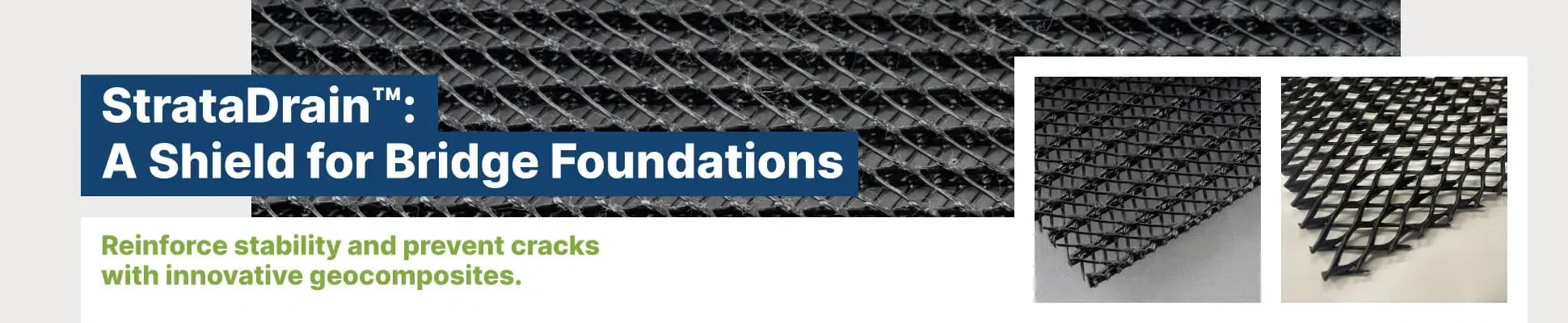
The engineering wonders built near rivers are susceptible to soil erosion, scouring, water pressure, and other environmental issues that lead to foundation cracks. These cracks can lead to serious problems making the bridge less stable, disrupting traffic, and even putting people’s safety at risk. StrataDrain has been proven to protect bridge foundations. In this blog, we’ll take a close look at foundation cracks, and find how StrataDrain can make soil more stable and structures stronger.
Common causes of foundation cracks
- Erosion of the soil: The flow of a river can transport soil from around a bridge’s foundation. This removal of supporting material is known as erosion. As the soil is eroded, foundation loses support, and thus, the structure (e.g., bridge) undergoes settlement. The earth and the man-made part can settle at different rates, which as a result can cause the bridge to develop cracks in it.
- Scouring: The water around the bridge piers excavates the soil, leading to scoured holes. The development of these holes causes a void under or around the foundation causing it to lose its support. This ultimately leads to an unstable bridge foundation.
- Hydrostatic pressure: The hydrostatic pressure in construction refers to pressure exerted by water against a structure or material due to its weight and density and is one of the most underestimated or often overlooked risks to the bridge’s foundation. Underground water causes hydrostatic pressure affecting bridge foundations. This force, as well as other causes such as soil being washed away and water scouring, can cause cracks to form in the foundation.
- Soil liquefaction: Water-laden soil during seismic activity can act like a liquid in quake-prone regions. This phenomenon is called liquefaction which often occurs in saturated, loose sandy soils during seismic activity. The liquefaction of the soil causes the foundation to lose its grip and load-bearing capacity, which in turn causes instability and possibly results in crack formation.
- Thermal movements: Bridges, as well as other structures, undergo heat-induced deformation that makes them expand or contract depending on the temperature variations. With the ever changing effects of global climate change, structures are more vulnerable than ever. Most construction materials, especially concrete, absorb a lot of heat. Thus, the foundation also undergoes pressure as a result of this movement. The restraint of this thermal expansion and contraction, particularly in the superstructure, can induce significant stresses in the foundation.
- Differential settlement: The two sides of the river bank may have different soil properties and compositions. Differential settlement is often due to variations in load distribution, soil type, and moisture content. This difference can cause the foundation to settle unevenly, with one side of the bridge sinking at a different pace than the other. This unevenness of settlement is also one of the reasons for stress on the structure, leading to fissures.
- Pier and abutment loading: Bridge weight, mainly supported by the piers and abutments, transmits pressure to the soil beneath. As time goes on, the earth can start to compress under this sustained pressure which, if uneven, results in differential settlement, hence, potentially contributing to foundation cracks.
What are the mitigation techniques?
While many structural challenges, such as soil movement, water accumulation, and material degradation, are well known and can be planned for, the amount of maintenance required for such structures often makes cost a major consideration. While many engineers do plan for the eventual degradation of structures, there are solutions available today that help reduce overall maintenance costs while still ensuring strong and reliable structures.
1. Scour protection with geotextiles:
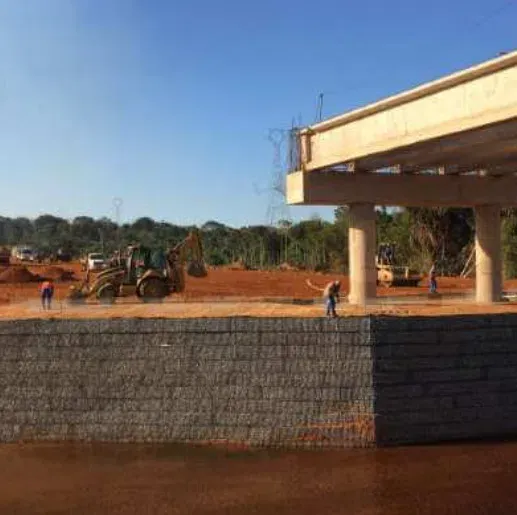
Scour, which is soil erosion around bridge piers, is one of the major factors threatening the stability of a bridge.
- Filter layer: The geotextile (like StrataTex HSR) acts like a filter layer around the piers. It allows water to pass through while retaining soil particles. This filter layer is typically used in conjunction with a protective layer of rock armor (riprap). The geotextile prevents the underlying soil from being washed out through the voids in the riprap, creating a stable, long-term scour countermeasure.
- Reinforcement: Geotextiles can act as a reinforced layer within or around the soil surrounding the pier, making the soil gain extra strength. By providing tensile strength, these geosynthetics hold the soil particles together, creating a cohesive mass that better resists the erosive forces of water.
- Bioengineering: Sometimes, a composite of geotextiles with vegetation could be used to create a living armouring of the pier. Apart from the provision of additional bank stability, vegetation roots will further improve the reinforcement of soil.
2. Geocomposite based soil improvement:
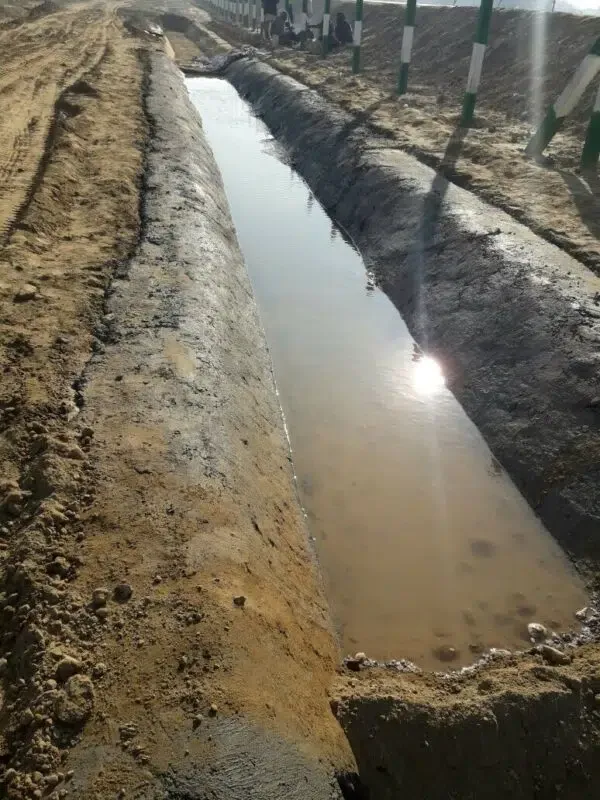
Excess water in the soil can lead to high hydrostatic pressure and low soil strength. Drainage geocomposites like StrataDrain are designed to solve this problem by removing the water.
- Improved soil strength via drainage: StrataDrain’s primary function is drainage. By removing water, it reduces pore water pressure and increases the soil’s effective stress. This improvement in effective stress directly increases the soil’s shear strength, which helps the foundation better resist applied loads.
- Drainage: Geocomposites like StrataDrain are good drainage materials. When they are installed in the soil, they act as a drainage path through which water can be evacuated; hence this reduces the hydrostatic pressure and can help mitigate soil liquefaction potential by facilitating drainage.
- Separation: Geocomposites (specifically those with geotextile components) aid in separating dissimilar soils. This prevents the blending of soils of differing properties, which may result in reduced load-bearing strength and deformation characteristics of the embankment and foundation system.
3. Deep foundations and geotextiles:
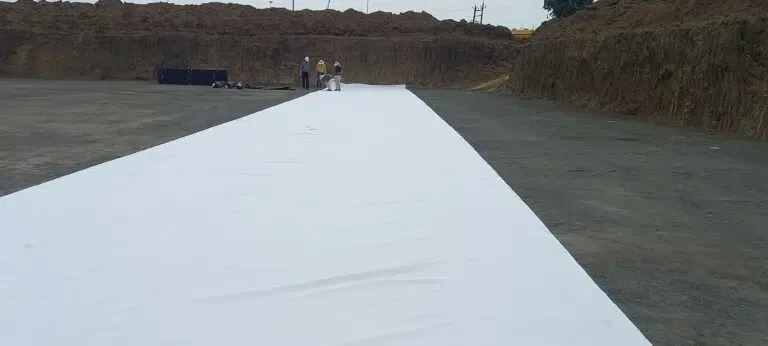
- Filter layer: The geotextiles can encase foundation elements like piles acting as a filter layer. This prevents the penetration of fine soil particles into the surrounding granular material or helps maintain the integrity of the soil-structure interface.
- Protection: Geotextiles can offer some protection against abrasion during installation or act as a separator between the foundation element and potentially aggressive soil environments.
What are the other applications of geocomposites?
1. Riverbank stabilization
The riverbanks are continuously subjected to the eroding forces caused by water currents. This causes the bridge foundation to be undermined by the embankment that was eroded.
- Erosion control: Laying geocomposites on the riverbank strengthens the soil and prevents it from being easily washed away.
- Vegetation establishment: Geocomposites provide a good medium for vegetation growth. The plant roots bind the soil and increase stability.
- Protection of bridge foundations: A stabilized riverbank minimizes scour and protects the foundation.
2. Drainage systems
An effective drainage system is vital to prevent water accumulation that can lead to hydrostatic pressure and instability of the foundation.
- Water removal: Geonets allow quick drainage of water and prevent pooling.
- Hydrostatic pressure reduction: Effective drainage reduces pressure on foundations and minimizes risk of cracking.
- Filter layer: Geonets are used with geotextiles to prevent clogging and ensure long-term performance.
3. Soil reinforcement
In situations requiring direct reinforcement, products like geogrids or high-strength geotextiles are used to add tensile strength to the soil, improving its load-bearing capacity and reducing settlement.
- Increased composite strength: Reinforcement geosynthetics act as tensile elements within the soil mass, increasing overall strength.
- Improved load-bearing capacity: Reinforced soil supports higher loads.
- Reduced settlement via reinforcement: Loads are distributed more effectively, reducing settlement.
- Accelerated consolidation: StrataDrain speeds up consolidation by dissipating pore water pressure.
By incorporating appropriate geosynthetics—such as geotextiles for scour protection, geogrids for reinforcement, and drainage geocomposites like StrataDrain for water infra—engineers can achieve greater performance and durability in bridge construction.
Case study
Client: Embalse EI Rizado
Location: Villena, Alicante, Spain
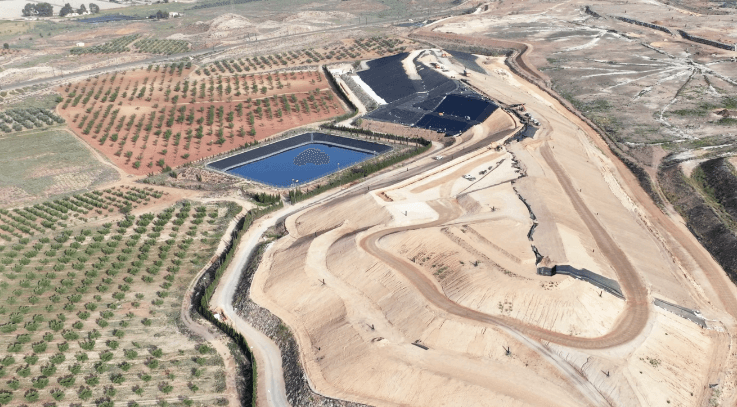
Strata Geosystems demonstrated its expertise in innovative solutions for environmental integration with the Surface Sealing and Post-Closure maintenance project at Villena’s MSW treatment plant Landfill. The project involved design and delivery for both rainwater drainage systems and gas collection. The client’s primary requirement was to effectively close the landfill while meeting all environmental regulations. An important challenge we faced during this project was the need to design anchor trenches within a confined space. Hence, we provided them with the best solution with our StrataDrain drainage composite and StrataGrid geogrid. In contrast to traditional approaches including gravel and common geotextiles, Strata’s solution offered high flow rate, enhanced design efficiency and a higher security factor. Characterized with high flow and low creep, StrataDrain is designed to withstand high compressive forces. Drainage composites provide a high-flow pathway to efficiently collect landfill gas, channeling it to a venting or extraction system and thereby preventing uncontrolled pressure buildup and emissions through the capping layer. By preventing the infiltration of particles into the drainage core, it averts clogging of the system. Take the step to ensure your project’s future is built on a solid, dependable foundation. Contact us now.