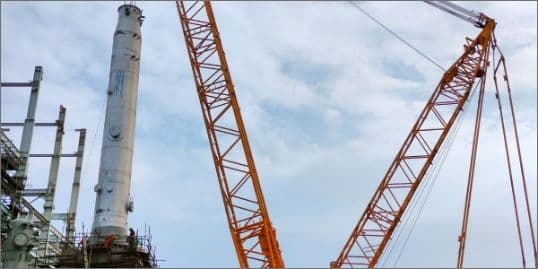
The client needed to increase the safe bearing capacity of the foundation soil below their crane hardstand. It is imperative to note that the hardstand’s foundation requires a bearing pressure of 300 kPa/sqm, while also accommodating a crane with a robust capacity of 1600 metric tons.
The subgrade of the existing area was weak, and the consultant had anticipated challenges with the required bearing capacity for the movement of the crane. The soil was also saturated due to its proximity to the sea and high rainfall zone.
The natural subgrade of the ground below the crane hardstand was very weak in bearing capacity. Due to the heavy weight of the crane, the client needed to ensure a robust foundation.
Settlement tolerance stands as the second critical criterion, following bearing capacity, in situations where a crane’s boom is tasked with handling valuable equipment, the weight of which is being lifted to a height above 10 meters. In such circumstances, compromising on differential settlements is not an option.
The conventional approach would have been a pile foundation of 1m diameter with a minimum 14 m depth that could withstand the loads of the crane movement.
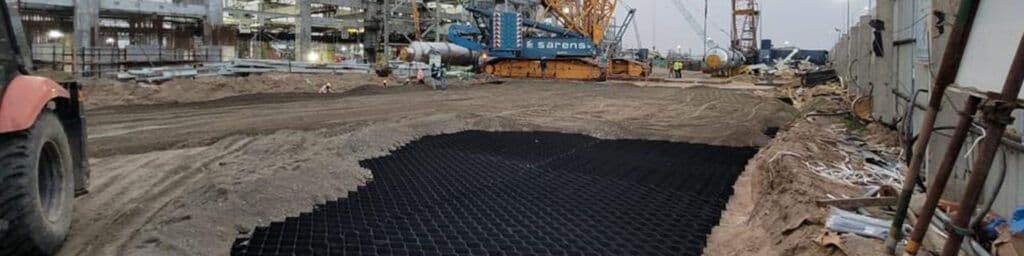
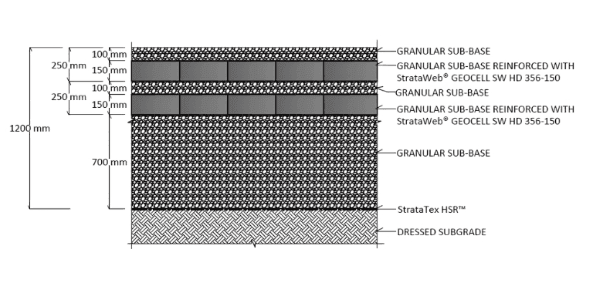
Strata proposed an innovative design where the hard stand section is reinforced with StrataWeb® geocell such that the safe bearing capacity of the soil is greater than the bearing pressure at the base of the hard stand. 13 such crane pads were built across the site to take any maintenance work afterwards for the plant’s design life, i.e., a minimum of 15 years. StrataTex HSR™ was used not only as a separator but also to ensure high tensile strength with minimum strain.
Strata’s value addition included faster execution of work due to the ease of installing StrataWeb® with unskilled labour. Providing a stable foundation for heavy loads. Also, the reduction in the aggregate thickness.