The invention of geosynthetic products has revolutionized the construction industry. Strata Geosystems has successfully established itself in the construction industry with revolutionary geotechnical products such as StrataGrid, StrataWeb, Sleeve-IT, StrataTex HSR, and StrataDrain. As trusted manufacturers and suppliers capable of meeting constantly evolving requirements, we serve clients in the construction industry, spanning from retaining walls to reinforced soil slopes and embankments in highways, landfills, mines, railways and many more areas. This comprehensive guide will discuss StrataDrain, an advanced drainage composite for drainage systems.
What is StrataDrain™?
StrataDrain is a geosynthetic material that has successfully replaced traditional drainage materials. As a geocomposite, it consists of a geonet core bonded with a geotextile fabric, a combination that offers high-flow drainage capacity. It’s manufactured with high-density polyethylene (HDPE) geonet and polypropylene nonwoven fabric bonded to one or both sides. The layers are fused together, creating a strong bond that resists separation. This fusion ensures excellent hydraulic performance and minimizes the risk of failure caused by the fabric component sliding on the drainage core. Because it’s designed to withstand harsh mechanical and chemical environments it is durable in conditions with a wide range of pH values, high temperatures, and significant compressive pressures.
The geotextile component acts as a filter and separator, allowing liquids or gasses to pass into the geonet core while preventing soil particles from clogging the system. This provides a clear pathway for water and gas, effectively managing seepage and preventing pressure buildup. Then, the geonet collects the liquids and gasses and passes them to the collection system.
The applications of StrataDrain include, right from being deployed for sheet interceptor drains behind retaining walls and reinforced steep slopes, landfill leachate transmission and collection systems, and multi-layered waterproofing and roof deck drainage systems. The most important feature is the relief of hydrostatic pressure within the soil mass or behind a structure. Since the geocomposite allows free passage of liquids, it improves the longevity of the entire structure, and prevents water related damage. By replacing the need for quarried aggregates like sand and gravel, it reduces the project’s carbon footprint, contributing to greater sustainability and a lower environmental impact compared to traditional methods.
Unique features of StrataDrain™
This geosynthetic composite comes with a 100-year guarantee and is EPD verified. However, these are not just the features that make StrataDrain a unique geosynthetic tool; what makes our product stand out for engineers:
- It is MORTH compliant (as per section 700-10) and manufactured under a stringent quality assurance program.
- It is extensively tested at our GAI-LAP and NABL-accredited lab. It is also ISO & CE certified.
- It can easily withstand high compressive forces.
- StrataDrain has a typical thickness of 4 to 7 mm and is laminated with a polypropylene (PP) nonwoven geotextile (ranging from 100 to 1000 gsm), which makes it more durable and long-lasting.
- The geonet core is manufactured using high-quality HDPE (High-Density Polyethylene) for high compressive strength, while the geotextile is made from durable PP (Polypropylene), creating a flexible and robust composite.
- The raw material used for manufacturing this geosynthetic material is UV-resistant, increasing its outdoor life.
Process of manufacturing StrataDrain™
StrataDrain is manufactured using the latest technology in Strata Geosystems’ state-of-the-art manufacturing unit. To manufacture this geosynthetic material, we follow a 3 step process from raw material to finished product with minimal human intervention:
- Extrusion: The first step is extrusion, which involves the HDPE granules. These granules and additives are mixed together as per the customer’s requirements. Then, this mixture goes through a drying process, where it removes excess moisture and is mixed with precision to attain optimum quality. The mixed material is then processed into HDPE plastic nets (geonets) in several sizes and patterns mainly biplanar and tri-planar geonets. If the geonets don’t require lamination, they are directly transferred to the packaging stage.
- Lamination cum slitting: The next step involves lamination. This is a precise process where geonets and geotextiles are laminated using thermal heating. The result is known as Drainage Composite or StrataDrain, which is available in various widths (e.g., up to 5m) and long, continuous rolls (e.g., up to 200m). The slitting operation is carried out depending on the customer’s requirements.
- Packaging: Once the geonets and geotextiles have gone through the processes of extrusion and lamination, they have reached the last stage, the packaging. The finished inventory is packed as a roll using HDPE sheets. The products that are to be exported are packed in special wooden pallets. The final product is packaged in durable wrapping to protect it during transport and on-site handling.
What are the benefits of using StrataDrain™?
StrataDrain has significantly changed the facet of the geomaterial industry. Since it manages hydrostatic pressure, which is necessary for structures such as retaining walls, slopes, or landfills as an example– it improves the long-term performance and preserves the structural integrity by preventing weakening caused by excess pore water pressure. By being multifunctional as a separator, filter, and drainage layer, it serves many purposes across a single use case:
- It prevents structural failures
- It also facilitates the construction in a timely manner.
- Being a sustainable and recyclable material, it reduces carbon footprint.
- StrataDrain is extensively designed for civil works, landfills and mining areas.
- It is cost-effective and economical as compared to traditional drainage solutions like sand or gravel layers.
- Another special feature of StrataDrain is that it is designed as an added layer for leak detection. Hence, it effectively helps in avoiding unwanted leakages and spillage.
- It helps remove any contaminated liquid, also known as leachate, from the site generated from water percolated through solid waste. It also helps dispose of all the wastewater easily.
- From a cost standpoint, installation is inexpensive, and thus reduces the overall cost of the project. Since it also minimizes the number of layers needed, i.e., multiple layers of different materials, it presents a simpler installation process.
How does StrataDrain™ cut civil work time?
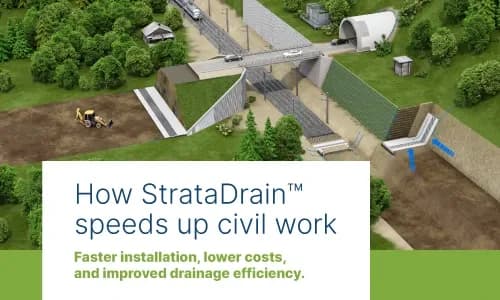
From an operational standpoint, civil engineers appreciate the efficiency StrataDrain brings to projects through its versatility:
- Easy handling and placement: StrataDrain can be quickly deployed because it requires lesser labor and equipment due to its flexibility and lightweight design.
- Minimal amount of excavation needed: Effective drainage minimizes the need for big excavations and narrower drainage trenches, which cuts down on preparation time.
- Integration with existing systems: It facilitates simple integration with existing drainage systems, streamlining the process and removing the need for laborious alterations.
- Easy installation: StrataDrain combines filtration, drainage, and separation capabilities into a single product, eliminating the need for multiple material layers and streamlining installation.
- Prefabricated design: StrataDrain’s is ready-to-use design in rolls quickens the construction process by removing the need for on-site fabrication and reducing the need for specialized skilled labor associated with placing and grading thick aggregate layers.
- Consistent quality: The factory-fused structure ensures consistent, dependable performance, thereby minimizing the risk of installation errors and costly rework .
Applications of StrataDrain™
If you are looking for a cost-effective and economical drainage solution, StrataDrain is your best option. Its multifaceted use makes it not just a cost-effective choice but also sustainable and safe for the environment. StrataDrain is a reliable solution for drainage challenges arising in the civil and landfill segments of the construction industry. Here is a detailed outline of its application in both segments:
1. Landfill solutions:
Strata Geosystems’ geosynthetic material has multiple functions when it comes to providing landfill solutions. Here are some of the important functions:
- Drainage of rainwater and gas collection: In landfill caps, StrataDrain effectively replaces thick traditional aggregate layers (up to 500-600 mm). It performs the dual function of draining rainwater off the cap while also providing a high-flow path for collecting landfill gases. Replacing quarried aggregate with StrataDrain reduces the project’s carbon footprint and preserves natural resources.
- Leachate Collection and Filtration: In a landfill lining system, StrataDrain is placed directly on top of the impermeable geomembrane liner. Here, it functions as a high-performance leachate collection layer. The geotextile component filters out waste particles while allowing contaminated liquid (leachate) to pass into the geonet core. The geonet core then provides a high-flow pathway to transport the leachate efficiently to a collection sump for proper disposal. This system prevents the buildup of hydraulic head on the primary liner, which is critical for the safety and integrity of the entire containment system.
- Leak Detection: For leak detection systems, StrataDrain is installed between a primary (upper) and a secondary (lower) geomembrane liner. If the primary liner is breached, leachate enters the StrataDrain layer, which quickly channels the fluid to a collection point. This signals a leak long before the secondary liner is compromised, acting as a critical early warning system and allowing for timely repairs.
2. Civil work:
- Vertical drainage:
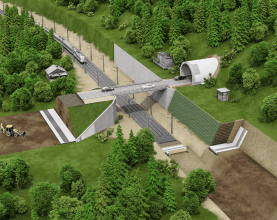
Our geomaterial significantly enhances the performance of vertical drainage structures like retaining walls and bridge abutments. - Horizontal drainage:
StrataDrain has been the most preferred filler option for engineers worldwide because of its quick and effective turnaround and easy construction setups. Longitudinal drainage:
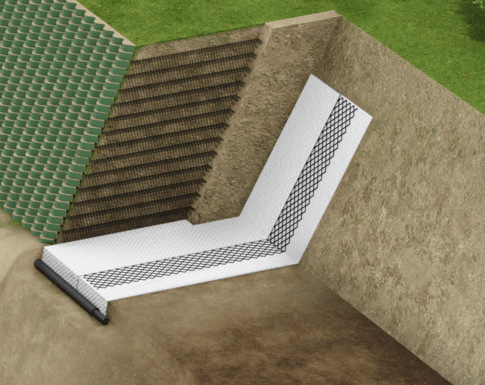
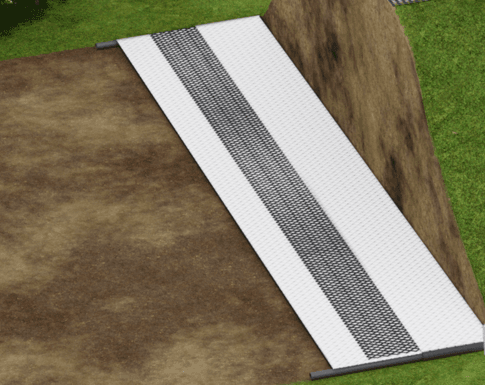
In simpler terms, StrataDrain can be used in longitudinal drains by providing a geocomposite drainage material along with drainage pipe of the required length. This will provide efficient drainage along the length of a structure (e.g., a highway or railway) and prevent flooding.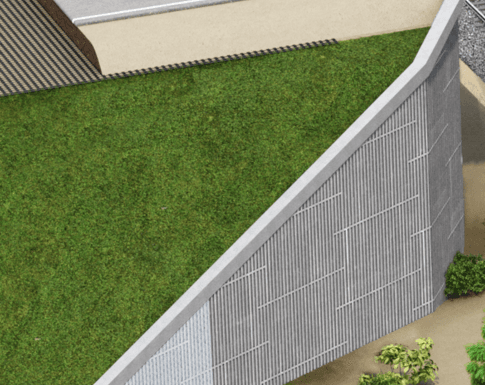
- Channels:
When used for lining channels, StrataDrain provides two key functions: it protects the channel bed and banks from the erosive forces of flowing water, and it allows for drainage of groundwater from behind the liner, reducing hydrostatic pressure and improving stability. It then channels this collected groundwater safely away, helping to restore and maintain the structural integrity of the infrastructure. - Tunnels:
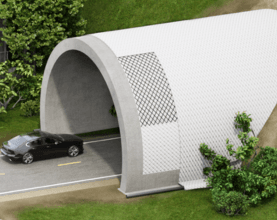
In tunneling, our geosynthetic is installed over the primary waterproofing membrane. It serves as a protection layer for the membrane during construction and acts as a drainage layer to collect and channel any seepage, preventing hydrostatic pressure from building up against the tunnel lining.