
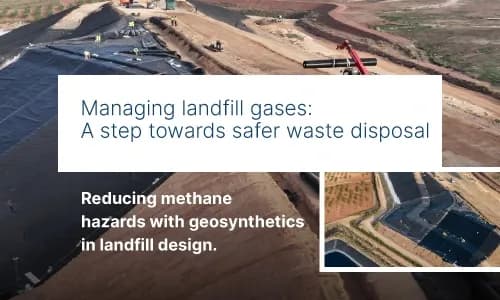
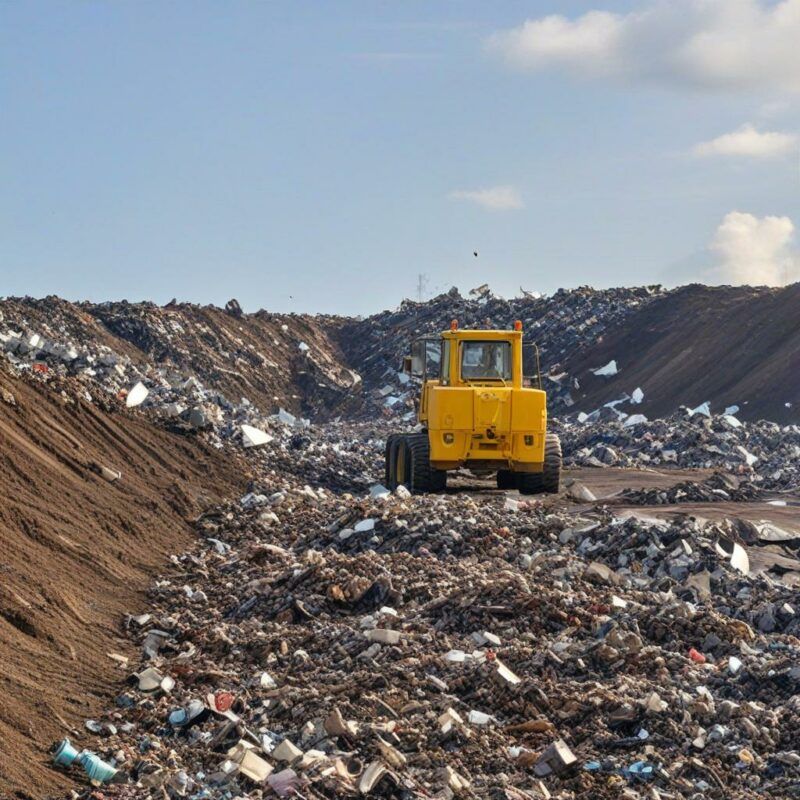
One of the primary challenges in landfill management is the accumulation and migration of landfill gases, such as methane and carbon dioxide, which are byproducts of organic waste decomposition. Without proper venting and detection systems, these gases can cause explosions, fires, and other hazardous conditions, not to mention contributing to greenhouse gas emissions. This is where the technology of gas venting and leak detection comes into play, ensuring landfills are safer for both the environment and surrounding communities.
Importance of gas venting in landfills
Landfills require dedicated venting mechanisms to safely release accumulated gases through the layers of waste. This process involves a gas collection system, where a network of pipes and vents captures landfill gases. Engineers install wells and pipes to capture landfill gas (LFG), which is either flared or converted into energy. This process not only reduces the volume of methane released into the atmosphere but also transforms a hazardous byproduct into a valuable resource. At Strata Geosystems, our drainage geocomposites create a highly efficient gas collection and venting layer, which is critical for managing fugitive emissions and safely controlling landfill gas.
Why is gas leak detection needed in landfills?
There are several reasons why gas leak detection is essential in landfills:
- Methane, a potent greenhouse gas, is produced as organic waste decomposes and can accumulate in high concentrations, creating explosion risks.
- Uncontrolled methane emissions contribute to climate change, making leak detection essential for reducing a landfill’s carbon footprint.
- Regulatory requirements mandate landfill operators to monitor and manage methane levels for worker and environmental safety.
- Identifying and repairing gas leaks enhances methane capture for energy production, improving landfill sustainability.
How geotextiles and geogrids work in gas venting?
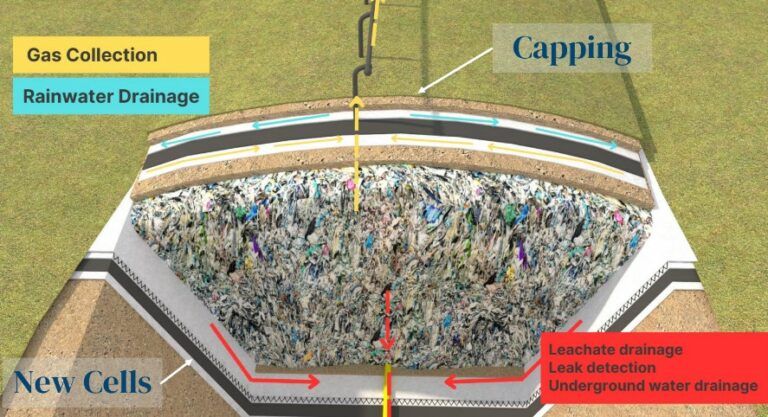
In an engineered landfill cap, geosynthetics create a multi-layered system designed for containment and environmental protection. A drainage layer, such as our proprietary product StrataDrain, is placed directly over the waste to function as a gas collection layer, safely transporting landfill gas to vents or a collection network. Above this, an impermeable geomembrane is installed to prevent rainwater from seeping into the waste. A second drainage layer of StrataDrain is often placed on top of this geomembrane to manage surface water, protecting the final cover soil.
It is important to distinguish this from the leachate collection system at the base of the landfill. In that application, StrataDrain is placed beneath the waste to collect contaminated liquid (leachate) and direct it to a sump for removal and treatment, preventing groundwater contamination.
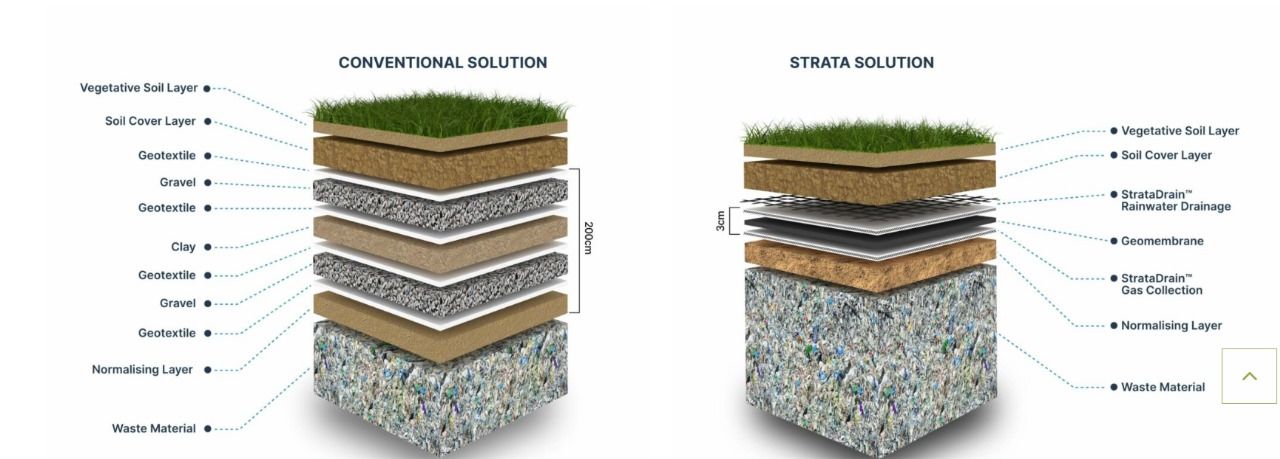
By using StrataDrain in these applications, we can replace a traditional 300mm to 600mm gravel layer with a 5-7mm thick geocomposite. This shift delivers three key benefits: cost savings of up to 20%, increased landfill capacity due to the thinner profile, and long-term durability from the material’s ability to resist high compressive stresses.
For the final landfill cover, we use StrataGrid for veneer reinforcement. Its primary function is to provide stability to the cover soil on steep slopes, preventing it from sliding down the smooth geomembrane liner. This method is cheaper than traditional quarrying and stone-pitching and requires minimal maintenance. For the surface layer, we use StrataWeb, a geocell system that confines soil to support a vegetative cover. This controls erosion and creates a more natural, aesthetically pleasant appearance—a dual benefit.
Geotechnical engineering and landfill design
Although landfills may not be viewed as architectural structures, a poorly designed landfill can be a serious environmental and safety hazard. Since many landfills today are legacy sites, they require innovative engineering solutions to maximize available space and capacity. Our designers and team of civil engineers work with you to consider soil characteristics, landfill geometry, and the expected volumes of waste to create a layout that optimizes gas venting efficiency. Our landfill solutions cover multiple applications, including capping and drainage with geogrids, geocells, geotextiles, and geomembranes; leachate management; landfill expansion (both vertical and horizontal); and access road development for dumper trucks. Due to limited landfill space, expanding capacity is a frequent challenge our clients face. From capacity recovery and airspace optimization to cost minimization, our landfill expertise spans multiple regions. With our expansion options, sites almost get a new lease of life. With increased containment capacity and extended landfill lifespan, we achieve sustainability without requiring additional approvals or incurring high costs. Our geosynthetic applications lead to more sustainable solutions for waste management companies. Choosing the appropriate materials depends on factors such as tensile strength, permeability, and compatibility with landfill contents. This is a crucial aspect of our site-specific design process. Reach out to us to learn more about our landfill case studies in India, Spain, and USA.
How do we design for both efficiency and safety?
The design of a landfill’s gas venting and detection system has to balance efficiency with safety. Our engineers design systems that can handle expected gas output throughout the landfill’s operational lifetime, considering both normal conditions and load expectations. This involves calculating the number and placement of gas wells, the sizing of pipes, and the integration of detection systems, all while considering the potential for future site expansion or changes in waste composition. Since these calculations are performed on active landfill sites, we implement checks and balances to minimize long-term ecological impact.
Monitoring and maintenance are essential for ensuring long-term landfill safety. Capacity expansion is a key reason clients seek our expertise, but we also ensure compliance with landfill regulations. Many countries enforce strict LFG emission regulations, with non-compliance leading to heavy fines and legal action. Our robust gas management systems help landfills reduce their environmental impact and meet regulatory standards.
Case study: Gas venting & drainage for Villena landfill
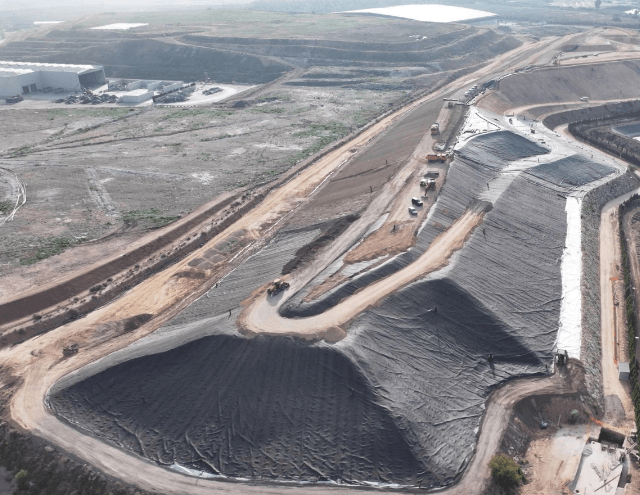
The surface sealing and post-closure maintenance project at Villena’s MSW treatment plant landfill showcases Strata Geosystems’ expertise in delivering innovative environmental solutions. Strata designed and implemented rainwater drainage and gas collection systems using StrataDrain composites. Additionally, StrataGrid was used to reinforce and stabilize landfill slopes.
Scope of the project and challenges
Strata aimed to safely close the landfill while ensuring environmental compliance. They faced the significant challenge of designing anchor trenches within a confined space. Strata developed a tailored installation methodology to efficiently manage space limitations.
The solutions offered by Strata Geosystems
Strata’s solutions offered several advantages over conventional methods involving gravels and common geotextiles:
- Higher flow rate: Ensured efficient drainage and gas venting.
- Improved design efficiency: Optimised the overall layout and functionality of the landfill closure.
- Lower overloads: Minimized stress on the landfill.
- Higher security factor: Enhanced the safety and stability of the landfill.
A key project highlight was Strata’s ability to tailor geosynthetic solutions to Villena’s challenging topography, showcasing its expertise in environmental engineering.
What does this mean for safety and sustainability?
Using gas venting and leak detection systems with geotextiles and geogrids underscores our commitment to safety and sustainability in waste management. As waste management evolves, civil engineers will focus on integrating these technologies to build safer, eco-friendly landfills. By innovating and following best practices, we can manage landfill gas risks and protect human health and the environment.